
Florence field review · GUIDED
Private Guided Tour of Florence Basilicas and Their Cloisters
Cloisters in Florence feel calmer than expected. This private guided circuit connects the big names in Florentine art with the Medici story, moving from Renaissance façades to quiet cloisters without the usual self-guided stress. You go with a local professional guide and stay limited to just your group, so the pace feels human.
I really like the art focus. You see heavyweight works like Giotto’s Crucifix, Masaccio’s Trinity, and Donatello pieces, then you watch the setting explain why they mattered. I also like the order of the visit, because the tour treats cloisters as more than decoration, from the Green Cloister to San Lorenzo’s orange-tree courtyard.
One thing to consider: several major churches charge entry fees that are not included, so you’ll want to budget extra and be ready for ticket lines at the stops. It’s also about three hours, so you won’t have a long sit-down in every chapel.
Key highlights to notice before you go
- Meet at Santa Maria Novella at 10:00 am and finish at Santa Croce so you see Florence’s religious center in one straight walk
- Giotto, Masaccio, and Donatello, plus fresco cycles that make the art feel connected, not random
- The Green Cloister at Santa Maria Novella with Paolo Uccello murals in green earth tones
- San Lorenzo’s Medici core, including Brunelleschi’s Old Sacristy and the Cloister of the Canons with the orange tree
- Santa Croce tombs of Michelangelo, Galileo, and Machiavelli paired with major frescoes and cloisters
When a guide is worth having beside you in Florence
- The Best tour in Florence: Renaissance & Medici Tales – guided by a STORYTELLER★ 5.0 · 12,316 reviews
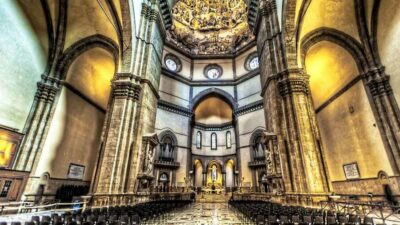
- Florence: Duomo Cathedral Guided Tour★ 3.9 · 5,970 reviews
- Uffizi Gallery Small Group Tour with Guide★ 4.5 · 4,923 reviews
- Florence: Accademia Gallery Guided Tour★ 4.6 · 4,156 reviews
Private Florence basilicas: why this 3-hour format works
Florence basilicas can swallow an entire day fast, and that’s why a focused route matters. This tour is designed to connect three giants of Florentine church life, Santa Maria Novella, San Lorenzo, and Santa Croce, while also threading in the public spaces around the Duomo and Medici power.
The private setup changes the feel. You’re not orbiting strangers while you try to hear the story of a fresco, a tomb, or a symbol like the orange tree in San Lorenzo. If your group includes older travelers, a good guide style matters, and guides like Alessandra (known for pacing and clear explanations) show how you can keep momentum without rushing.
You’ll also get earphones for larger groups, which helps if you’re more than seven people. And because the tour ends at Santa Croce after visiting key plazas, you leave with a mental map of where art, politics, and faith overlapped.
Santa Maria Novella and the Green Cloister: Alberti’s façade to Uccello murals
The tour starts at Basilica of Santa Maria Novella in the square, right where the famous Renaissance façade rises in white and green marble. The façade is attributed to Leon Battista Alberti, and your guide’s job here is to give you the “what to look for” lens so the building makes sense, not just looks pretty.
Inside, you’re not doing a quick glance-and-go. You have time to focus on major works, including:
- Giotto’s Crucifix
- Masaccio’s Trinity
- frescoes connected with Filippino Lippi and Ghirlandaio
This matters because these paintings don’t sit in isolation. The church was founded by the Dominican Fathers at the start of the 1200s, and your guide explains what that meant for the space and the art style. You get context about the Dominican presence and the mendicant order, which helps you understand why the storytelling felt so deliberate.
Then the mood shifts from church interiors to the cloister courtyard. The tour ends inside the Green Cloister, named for its murals painted in green earth tones by Paolo Uccello. This is one of those Florence details that’s easy to miss when you’re rushing through on your own. In a guided visit, you’re more likely to notice how the cloister setting turns art into a daily ritual, not a one-time “see it once” stop.
Practical tip: San Maria Novella and the cloister area can involve moving between zones indoors and outdoors. Wear comfy shoes. Also, if you’re the type who likes photos, you’ll want to pause when your guide points out the mural sections, not just when you pass them.
San Lorenzo and the Medici machine: Old Sacristy, tombs, and the orange tree
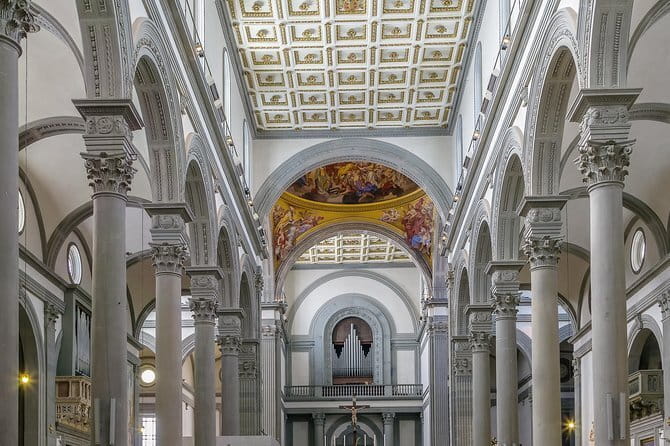
Next you head to Basilica di San Lorenzo, the area where the Medici story becomes physical. Florence’s oldest church is consecrated in 393 and later rebuilt and enlarged over time, with Brunelleschi playing a major role in the 1400s under Medici direction. Your guide ties this timeline to why the Medici families treated this site as their own spiritual and political base.
Inside, the highlight is the Old Sacristy by Brunelleschi, where the Medici founders’ tombs and major artworks converge. You’ll also hear about the artists whose work fills the space, including Donatello, Bronzino, Filippo Lippi, Rosso Fiorentino, and Pontormo. Even if you only know a few names, the guide will help you connect them to the bigger shift in Florentine art during the Renaissance.
San Lorenzo is also a lesson in how power works through design. The church is not only a place of worship, it’s a brand, a monument, a family statement. That’s why the tour spends real time here.
After the church, you move into the Cloister of the Canons. The center point is the 16th-century orange tree, which your guide explains as a symbol strongly tied to the Medici dynasty. It’s the kind of detail that sounds small until someone explains why a courtyard object can carry meaning across centuries. You’ll likely remember this part more than another grand wall because it’s specific and symbolic, not generic.
A consideration: San Lorenzo’s areas can require a bit of walking while maintaining focus. If your group needs slower breaks, ask your guide to pace accordingly. The best guides, like those highlighted in past experiences, know when to slow down and when to keep going.
Piazza del Duomo: getting the big religious picture in ten minutes
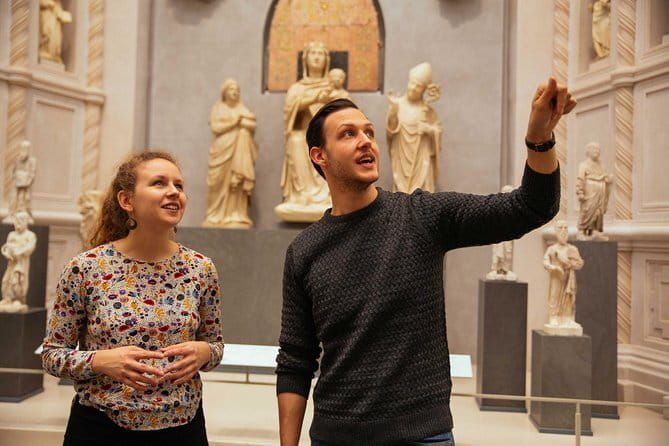
After San Lorenzo, you step into Piazza del Duomo, Florence’s religious center. This is one of the most famous outdoor zones in the city, but ten minutes can still be worthwhile if you know what you’re looking for.
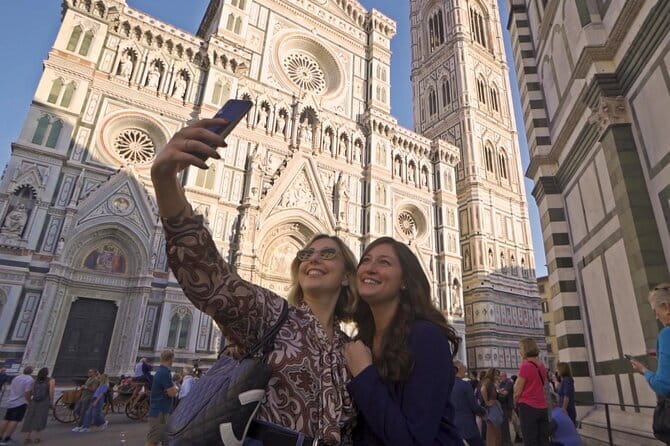
From the square, you’ll be able to admire the Cathedral, the Dome, the Baptistery, and Giotto’s Campanile. Your guide helps you connect these landmarks so they feel like one idea rather than four separate monuments.
Is ten minutes enough for Duomo-area perfection? No. But this isn’t trying to replace a full Duomo ticket day. It works as a “settle your brain” stop, giving you structure before you move into the political art zones and the tomb-heavy finale at Santa Croce.
If you’re sensitive to crowds or sun, this plaza can get busy. Keep water handy and plan for light wind, especially in warmer months. The tour’s short stop means you can reposition quickly if the crowd thickens.
Piazza della Signoria and the Medici story in public art
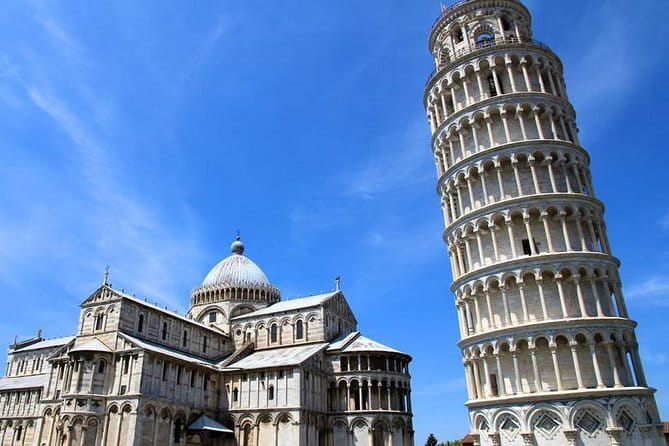
Then you reach Piazza della Signoria, described as a concentration of architectural and sculptural masterpieces. This square is where you feel Florence’s identity as a city that performs art in public.
The practical value here is context. Your guide connects the square to the Medici family, explaining how their story ran alongside the city for more than three centuries. You’re not just seeing statues and façades, you’re learning how Florence used civic space to project power.
This stop is brief, about ten minutes, but it’s exactly the right kind of short. It keeps the tour moving while you still get the “why this matters” narrative. Think of it like the stage directions before the main act.
If you love people-watching, this is also a good point to take a quick look around and get oriented. The square helps you understand the city’s geography so that later, when you roam on your own, you don’t feel like you’re wandering blind.
Private Florence options for a day with fewer compromises

Santa Croce: tombs of Michelangelo, Galileo, and Machiavelli plus two cloisters
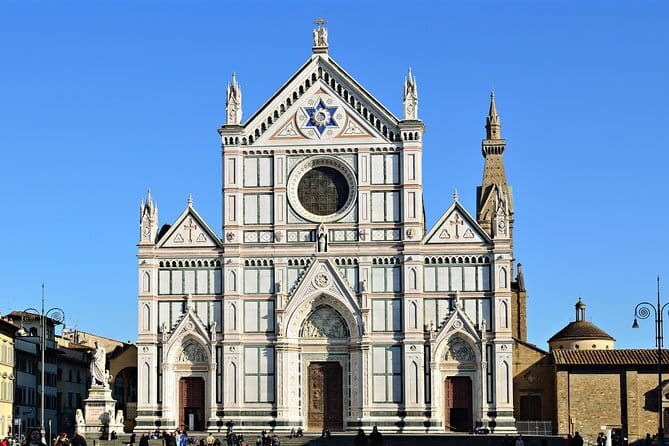
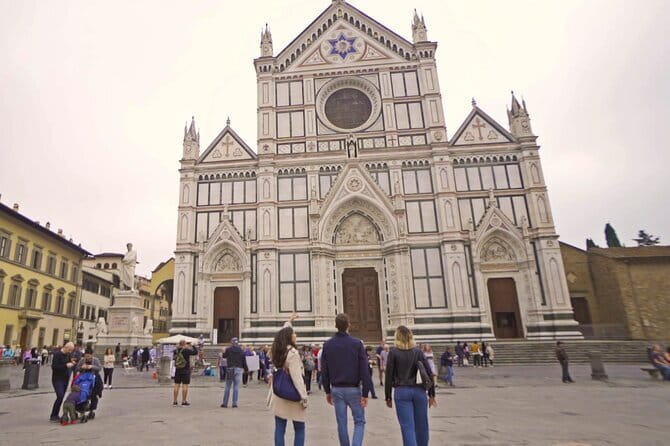
The tour ends at Basilica of Santa Croce, and it’s a strong finale. Santa Croce is Gothic in spirit with a façade clad in polychrome marble, which gives it a dramatic look from the outside. Your guide also brings in an interesting early story about the Franciscan friars, including that the church area was tied to leatherwork and that it was once outside the city walls when they began treating pelts and leather and meditating in peace.
Inside, you get both frescoes and famous works:
- frescoes by Giotto and Agnolo Gaddi
- Donatello’s Crucifix and Annunciation
Then comes the part many people remember most. Santa Croce houses famous funerary monuments and tombs, including Michelangelo, Galileo, and Machiavelli. This is where the church feels like a memory machine. You’re not only seeing art, you’re standing in the visual record of who mattered enough to be preserved here.
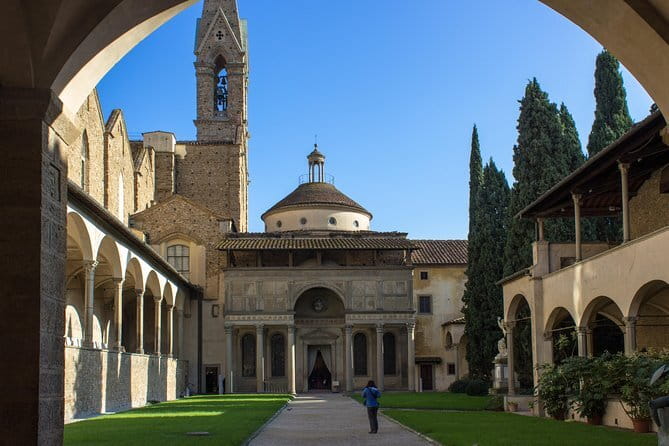
But the tour doesn’t stop at the interior. You enter the Brunelleschi Cloister, with columns carved from pure stone, and then continue into the Ancient Cloister. At the end lies the Pazzi Chapel, described as a sublime example of Renaissance harmony and connected here to Brunelleschi. In practical terms, this is a well-paced way to see how Santa Croce uses layered spaces, not just one big hall.
Time-wise, the Santa Croce portion is long enough to feel like a finish line, about fifty minutes, without running you out of energy. If you like taking a moment to stand back and absorb, Santa Croce gives you places to do that without feeling like you’re missing the rest.
A drawback to keep in mind: because you’re seeing several “heavy hitter” sites back-to-back, you may feel a bit art-saturated by the end. If you’re the kind of visitor who prefers one church and one theme, consider pairing this with lighter time afterward, like a short gelato stop and a relaxed walk along the Arno.
Price, tickets, and what you’re really paying for
The tour price is $205.47 per person for about three hours. It’s not just walking through churches. You’re paying for a guide to translate a lot of complex art and architecture into a story you can actually follow.
Here’s where value becomes clearer. The tour includes:
- a local professional guide
- earphones for groups of more than seven participants
But it does not include admission tickets for several stops. You’ll pay on the spot for:
- San Lorenzo Basilica: adult €6.00
- Santa Croce Basilica: adult €8.00
- Santa Maria Novella Basilica: adult €7.50
So, for an adult, you should expect roughly €21.50 in entry fees on top of the tour price, depending on exact ticket rules in place that day. For many travelers, that extra cost is normal for Florence’s top churches. The key is whether the guide’s explanation makes that cost feel worth it.
This tour tends to justify the price because it targets the places that are most likely to feel confusing without help. Santa Maria Novella has major paintings, but knowing what to focus on is everything. San Lorenzo can look like one large complex until someone shows you how the Medici plan the space. Santa Croce has tombs that are impressive even if you’re not a scholar, but the best experience comes from linking names, artworks, and architecture into one chain.
One more value point: this is booked far in advance on average. That’s a hint that the private timing and the tight route are in demand, so if your dates are set, don’t wait too long.
Who this tour suits best, and who might want a longer day
This is a great fit if you:
- want a structured Florence intro focused on basilicas and cloisters
- love major artists like Giotto, Masaccio, Donatello, and the Medici story
- prefer a private format where the guide can adjust to your pace and questions
- are traveling with multiple generations, since guides like Alessandra have been described as maintaining a comfortable rhythm
It might be less ideal if you:
- want to linger for an hour in a single chapel or tomb complex
- plan to do photography-heavy work without interruptions
- dislike paying separate church entry fees on the spot
If you do want a slower pace, you can still do this tour and then return to your favorite stop afterward. The good news is that the route helps you choose which basilica you actually want to revisit, instead of guessing.
Should you book this private basilicas and cloisters tour?
I’d book it if your Florence time is limited and you want the best chance of understanding what you’re seeing. The route is compact, the art is top tier, and the cloisters give you moments of calm that a busy city day can’t always provide.
I would not book it if you’re the kind of traveler who needs long, quiet hours inside one site to feel satisfied. For that, you might choose a longer standalone church visit and spend more time with fewer stops.
If you’re on the fence, use this quick checklist:
- Are you excited by Giotto, Masaccio, Donatello, and Medici symbolism?
- Do you like moving efficiently with a guide so you don’t miss key stories?
- Can you handle paying a few separate entry tickets for the major basilicas?
If you answered yes to those, this private basilicas-and-cloisters tour is a smart way to get real value from a short morning in Florence.
FAQ
Where does the tour start and end?
The tour starts at Basilica of Santa Maria Novella, Piazza di Santa Maria Novella 18, 50123 Firenze FI, Italy. It ends at Basilica of Santa Croce in Florence, Piazza di Santa Croce 16, 50122 Firenze FI, Italy.
What time does the tour start?
The start time is 10:00 am.
How long is the tour?
The duration is approximately 3 hours.
Is this a private tour?
Yes. It’s listed as a private tour or activity, limited to just your group.
What’s included in the price?
A local professional guide is included, and earphones are provided for groups of more than 7 participants.
Are church admission tickets included?
No. Tickets are not included for San Lorenzo, Santa Croce, and Santa Maria Novella, and you pay on the spot.
Which basilas and sites are covered?
You’ll visit Basilica of Santa Maria Novella (including the Green Cloister), Basilica di San Lorenzo (including the Old Sacristy and Cloister of the Canons), Piazza del Duomo, Piazza della Signoria, and finish at Basilica of Santa Croce (including Brunelleschi Cloister and the Ancient Cloister area with the Pazzi Chapel).
What language is the tour offered in?
The tour is offered in English.
What is the cancellation policy?
Free cancellation is available. You can cancel up to 24 hours in advance for a full refund. Changes made less than 24 hours before the start time are not accepted.
Florence with someone who knows the room
- The Best tour in Florence: Renaissance & Medici Tales – guided by a STORYTELLER
★ 5.0 · 12,316 reviews
More Florence tours to open next
- The Best tour in Florence: Renaissance & Medici Tales – guided by a STORYTELLER
★ 5.0 · 12,316 reviews
Every Florence review, in one place
- Tuscany Day Trip from Florence: Siena, San Gimignano, Pisa and Lunch at a Winery
★ 5.0 · 21,634 reviews - The Best tour in Florence: Renaissance & Medici Tales – guided by a STORYTELLER
★ 5.0 · 12,316 reviews

Florence picks that sit just beyond this itinerary
- One Hour Uffizi Guided Tour: Masterpieces of the Renaissance
★ 5.0 · 3 reviews - Sightseeing Tuscany by touring bike – 1 day rental
★ 5.0 · 3 reviews - Private Siena, S. Gimignano, Chianti Road and Wine Tasting
★ 5.0 · 3 reviews - Bargello Museum Private Tour: Michelangelo’s Bacchus & Donatello’s David
★ 5.0 · 3 reviews - Authentic Florence Cooking Class at Costanza’s 1839 Family Estate
★ 5.0 · 3 reviews - San Gimignano and Volterra private tour: etruscans, romans and middle age jewels
★ 5.0 · 3 reviews
More Guided worth comparing.
 ★ 5.0The Best tour in Florence: Renaissance & Medici Tales – guided by a STORYTELLERFrom $312,316 reviews
 ★ 3.9Duomo Cathedral Guided TourFrom $155,970 reviews
 ★ 4.5Uffizi Gallery Small Group Tour with GuideFrom $764,923 reviews
Accademia Gallery Guided TourFrom $534,156 reviews
★ 4.5Uffizi Gallery Small Group Tour with GuideFrom $764,923 reviews
Accademia Gallery Guided TourFrom $534,156 reviews
 ★ 4.1Duomo Guided Tour with Optional Dome Climb UpgradeFrom $253,706 reviews
 ★ 4.5Guided Walking TourFrom $313,334 reviews
 ★ 4.5Skip-the-Line Accademia Guided TourFrom $432,327 reviews
 ★ 4.6Accademia Gallery Guided Tour with Entry TicketFrom $492,253 reviews