
Florence field review · MEDICI FLORENCE & RENAISSANCE STORIES
Renaissance Florence & the rivalry of Michelangelo and Leonardo
Michelangelo versus Leonardo, told street by street. This tour is a smart way to understand Renaissance Florence through the personalities and rival techniques of two giants, not just through famous masterpieces. I especially love the way the guide connects art to politics and power, and I love the payoff at the end in Basilica di Santo Spirito for Michelangelo’s young wooden crucifix, Il Crocifisso Ligneo. One possible drawback: several stops are exterior-only, including Palazzo Vecchio and the Duomo complex, so if you want lots of indoor time, you may need extra tickets on your own.
I also like that the pacing works: you start in the political heart of the city, then move into church and neighborhood Florence, finishing near Santa Croce. If you are trying to see the classics but still want a fresh angle, this rivalry story gives you a reason to pay attention at every corner. The group stays small, up to 16 people, which helps the guide keep the conversation moving without turning it into a rushed line.
Key things to know before you go
- Michelangelo vs Leonardo, explained through Florence street-level landmarks
- Santo Spirito visit includes the ticket for Il Crocifisso Ligneo
- Most key sights are exterior views, with a focus on how and why they matter
- Max group size is 16, so questions do not get lost
- Antonio’s code includes practical recommendations for food, music, drinks, and museums
More Medici stories behind the palaces, paintings and city streets
- The Best tour in Florence: Renaissance & Medici Tales – guided by a STORYTELLER★ 5.0 · 12,316 reviews
- Florence: Renaissance and Medici Tales Guided Walking Tour★ 4.8 · 1,549 reviews
- Florence: Mysteries of the Medici Guided Walking Tour★ 4.4 · 940 reviews
- Accademia Gallery: Michelangelo’s David and High Renaissance Art★ 4.0 · 872 reviews
Renaissance Florence, told through a rivalry you can actually feel
If you think Renaissance Florence is only about big-name paintings, this tour nudges you toward the bigger story. The central idea is that Michelangelo and Leonardo were not just artists in isolation. They were driven by competition, trained by the times, and shaped by the politics and culture of Florence.
You walk with that tension in mind. The guide keeps bringing you back to the question of how art gets made: technique, anatomy, patronage, and public image. You will still pass the city’s headline sights, but you will understand them more like a living argument between two minds than like a checklist.
Michelangelo and Leonardo, why this combo works for a 3-hour walk
This is the kind of theme that stays fun even when the buildings start looking similar. Michelangelo and Leonardo represent different instincts. One tends to push the human form with intensity, while the other is tied to observation and invention. The tour uses those contrasts to teach you how Renaissance artists thought and worked.
What I like most is that the theme does not float in the clouds. It gets pulled down into real places, like Florence’s civic center, Medici-linked churches, and a less famous Michelangelo work housed in Santo Spirito. You end the tour seeing how an artist’s tools and training become a visual language you can recognize.
And yes, the guide is Antonio. The standout point from feedback is that Antonio is funny and knowledgeable, and he can explain big ideas without making it sound like a lecture. That matters on a walking tour, because attention is fragile.
Stop 1 at Palazzo Vecchio, the city’s power theater
You start at Piazza della Signoria, but your first landmark stop is Palazzo Vecchio. From outside, the building hits you immediately. It is monumental and built to project authority. Even without going inside, it sets the tone: this is Florence showing off who runs things.
In Renaissance Florence, art was not separate from politics. Public spaces and official buildings shaped reputations. That is why starting here is smart. It makes the later church stops and Medici connections feel earned, not random.
Timing note: you spend about 15 minutes at the Palazzo Vecchio exterior. That is enough to orient you and connect it to what comes next. If you want full interior access, plan to add it later since admission is not included.
Piazza della Signoria, an open-air art gallery with political teeth
Next you move through Piazza della Signoria, Florence’s long-running civic hub. You are walking into an open-air museum where art and government share the same address. The square has statues and sculptures that turn the politics of the city into something you can see, not just read about.
A few highlights you will encounter in the square:
- Loggia dei Lanzi, an outdoor sculpture gallery with major works by artists such as Benvenuto Cellini and Giambologna
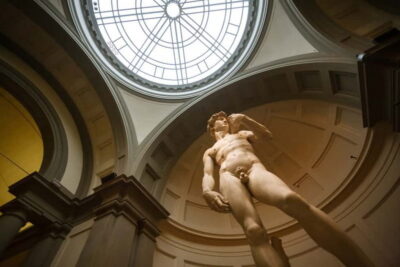
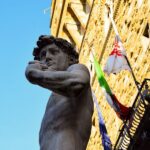
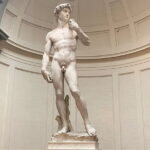
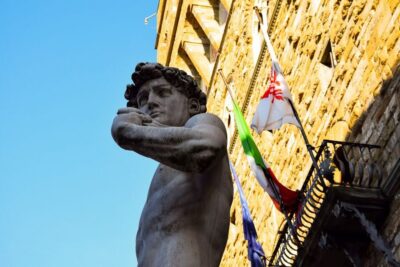
- A replica of Michelangelo’s David. Even as a copy, it is a strong moment because it tells you how important that image became to Florence’s identity
- The Fountain of Neptune area, which adds a layer of theatrical public display to the whole scene
The tour keeps this part tight, about 15 minutes. That short window is the right length for this square because the buildings and sculptures are dense. Use it to get oriented, then linger on your own if something grabs you.
The Duomo exteriors, Brunelleschi’s dome math you can picture

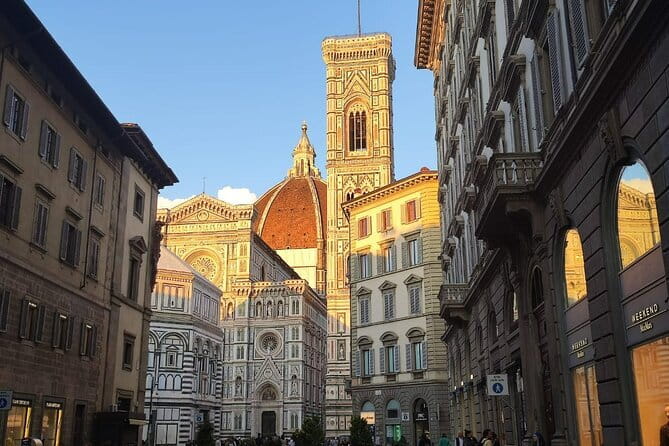
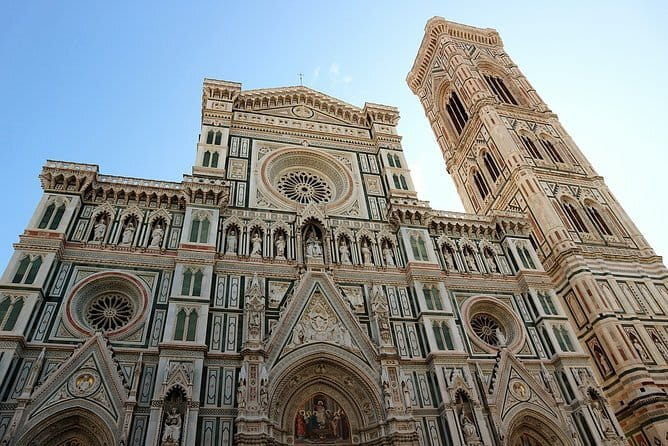
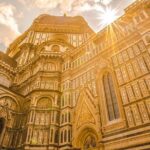
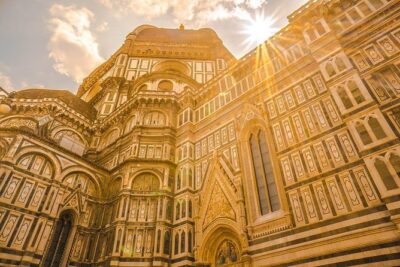
You then head to Santa Maria del Fiore (the Duomo) area for exterior views of the cathedral, Giotto’s bell tower, and the Baptistery of St. John.
This is one of those moments where the tour earns its theme. The guide does not treat the Duomo as just architecture. It frames it as Renaissance problem-solving. Brunelleschi’s dome is described as a major engineering feat, using a double shell and a herringbone brick pattern for stability. That kind of detail helps you look at the structure like a set of decisions, not just a big dome.
You also get the story of the bell tower. Giotto designed it, though he only saw the early levels. Andrea Pisano and Francesco Talenti carried it to completion. That adds a reality check: even masterpieces take teamwork across time.
Timing note: this is about 30 minutes and admission tickets are not included. If you want to go inside the cathedral or do a climb, you will need to plan separately.

San Lorenzo, Medici power, and Michelangelo’s fingerprints
After the Duomo area, you move to San Lorenzo and the square around it. This is where the tour’s Michelangelo thread starts feeling more personal.
You see:
- Basilica di San Lorenzo, connected to the Medici family as their parish church
- The Medici Chapels, serving as a mausoleum for the family
- The New Sacristy, designed by Michelangelo, which is one of the key Renaissance art and sculpture statements tied to Medici patronage
- The Laurentian Library and Michelangelo’s design work, including the distinctive staircase
Even if you do not go into everything, the guide’s explanation helps you understand why these sites matter. The Medici were not just funding art. They were shaping how Florence wanted to be remembered.
You also get a brief chance around the area for the San Lorenzo Market area. The market is free to wander in this tour context, and it can be a nice reset before the walk continues.
Timing note: about 30 minutes total here, with admission not required for the market-area stops.
Piazza Santa Trinita to Ponte Vecchio, history at walking speed
From San Lorenzo you shift to calmer, more neighborhood-feeling Florence.
At Piazza Santa Trinita, you get views connected to Via de’ Tornabuoni, one of the city’s more elegant streets known for historic buildings and luxury shopping. The square is small, but that makes it a good breather between bigger monuments.
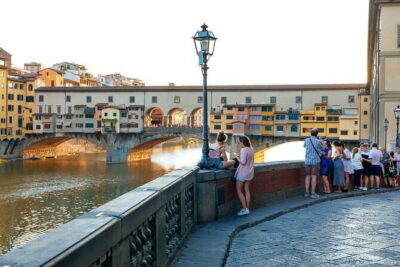
Then you reach Ponte Vecchio, the iconic bridge over the Arno. This is a stop designed for atmosphere. The bridge is famous for its distinctive structure and long-running history, and in a short amount of time you can see how it fits into the city’s daily rhythm.
Timing note: each of these is brief, about 10 minutes. The goal is not to exhaust them. It is to place them on your mental map so you can return later if you want.
Basilica di Santo Spirito, Il Crocifisso Ligneo and Michelangelo at 17
The tour’s real curveball is the last big stop: Basilica di Santo Spirito in the Oltrarno area. You get about 30 minutes here, and the ticket for Michelangelo’s wooden crucifix is included.
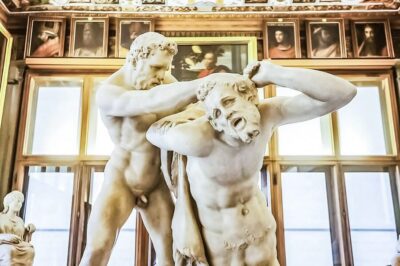
This is where the rivalry theme gets grounded in a very specific story. You are there to see Il Crocifisso Ligneo, an early masterpiece created when Michelangelo was only 17 years old. The work was made to thank a prior for allowing him to study anatomy. That detail is powerful because it links a single object to a bigger shift in how Michelangelo understood the human form.
Even if you are not a diehard art fan, you will likely feel the difference between seeing a sculpture in a museum and seeing a piece tied to a personal turning point. It is early Michelangelo, not mature Michelangelo. The focus is on training, access, and the discipline behind the later brilliance everyone knows.
This also explains why the tour finishes here. Santo Spirito is quieter than the usual headline crowd, so you get your emotional payoff without being crushed by the widest tourist flows. It is a great way to end a theme tour, because it gives you something concrete to remember.
Antonio’s code: the practical bonus that keeps helping after the tour
A walking tour is good for information. A great one gives you next steps.
This experience includes Antonio’s code, described as key Florence books and the best venues for food, music, drinks, and museums. That is not fluff. It helps you plan the rest of your trip with fewer wrong turns, especially if it is your first time in Florence and you want places that feel local rather than automatic.
In the feedback, Antonio comes across as both funny and knowledgeable, which is exactly what you want when you are mixing art history with practical city advice. If you like having someone steer you toward smart choices, this kind of included recommendation is real value.
Price and value for a 3-hour Florence art-and-history tour
At $31.35 per person for about 3 hours, the price is not just for a walk. You are paying for a professional local guide, structured storytelling, and an included ticket tied to the Michelangelo wooden crucifix.
Two things drive value here:
- Most stops are built around landmark exteriors that still need context to make sense
- The included Santo Spirito ticket is a tangible add-on, since you are not doing that part on your own
Is it the cheapest thing you can do in Florence? Probably not. But it is a focused way to spend time, especially if you want more than the obvious highlights.
Practical stuff: what to expect on the ground
- Duration: about 3 hours
- Group size: maximum 16 people
- Ticket type: mobile ticket
- Start and end: you begin in Piazza della Signoria at 10:00 am and finish in front of Santa Croce
- Weather matters: the tour needs good weather, and if it is canceled you should expect an alternative date or a refund
- What is not included: Palazzo Vecchio and Duomo complex admission tickets, plus gratuity
- Accessibility: service animals are allowed, and it says most people can participate
- Transport: it is near public transportation
One more thought if you are planning your day: because the tour includes several exterior-only segments, you may want to keep your schedule flexible after. That way, if you spot something you want to see inside, you can add it.
Should you book this Michelangelo and Leonardo tour?
If you want a Florence experience that is not just picture-taking at the usual stops, I think this is a strong choice. The Michelangelo versus Leonardo angle gives you a clear lens, and the Santa Spirito finale with Il Crocifisso Ligneo is a rare opportunity you might not find on your own.
Book it if:
- You like art history but want it explained with stories and real context
- You prefer a guided walk that keeps moving instead of sitting in one museum
- You enjoy small-group tours where the guide can stay interactive
Skip or add extra planning if:
- You mainly want interior visits and timed museum entries, since parts of the route are exterior and key admissions are not included
Overall, this is a smart 3-hour use of your time. You leave with more than facts. You leave with a sharper sense of why Renaissance artists fought so hard to be seen.
Every Florence review, in one place
- Tuscany Day Trip from Florence: Siena, San Gimignano, Pisa and Lunch at a Winery
★ 5.0 · 21,634 reviews - The Best tour in Florence: Renaissance & Medici Tales – guided by a STORYTELLER
★ 5.0 · 12,316 reviews

The Medici thread through Florence
- The Best tour in Florence: Renaissance & Medici Tales – guided by a STORYTELLER
★ 5.0 · 12,316 reviews
Florence picks that sit just beyond this itinerary
- Florence: Duomo Complex Private Guided Tour & Optional Dome Climb
★ 5.0 · 4 reviews - Private Tour of Florence Cathedral, Bell Tower & Baptistery
★ 5.0 · 4 reviews - Michelangelo’s David Tour in the Accademia (Tickets NOT included)
★ 4.0 · 4 reviews - Exclusive Pisa Tour from Florence: With Skip-the-Line Access
★ 4.0 · 4 reviews - Full-Day Tour of Tuscany from Florence-small group up 8 pax
★ 4.5 · 4 reviews - Florence: Inferno Private Walking Tour
★ 5.0 · 4 reviews
More Medici Florence & Renaissance Stories worth comparing.
 ★ 5.0The Best tour in Florence: Renaissance & Medici Tales – guided by a STORYTELLERFrom $312,316 reviews
 ★ 5.0The Best Tour in Florence: Renaissance and Medici TalesFrom $310,810 reviews
 ★ 4.8Renaissance and Medici Tales Guided Walking TourFrom $21,549 reviews
 ★ 4.4Mysteries of the Medici Guided Walking TourFrom $31940 reviews
 ★ 4.0Accademia Gallery: Michelangelo’s David and High Renaissance ArtFrom $43872 reviews
 ★ 4.7Guided Tour of Medici Family Secrets and ChapelsFrom $93512 reviews
 ★ 5.0Florence Private Tour: Renaissance, Famous Families & Hidden GemsFrom $199233 reviews
 ★ 4.5Pitti Palace, Palatina Gallery and the Medici: Arts and Power in Florence.From $82223 reviews
Find this experience in another shortlist