
Florence field review · UFFIZI GALLERY TICKETS & TOURS
Museums special: Accademia & Uffizi combo tour – monolingual small group tour
Florence’s art hits fast. This Accademia and Uffizi combo gives you reserved, skip-the-line entry and a guide who keeps the big stories clear, from Michelangelo’s David to Botticelli’s famous myth scenes. I especially like the small-group feel (max 15) and the way the guide turns each room into an easy-to-follow tour, not just a checklist. One thing to plan for: on the busiest days and in mid-day time slots, you can still hit short delays for security or entry, even with reservations, and you will do some walking between stops.
What makes it worth your time is the pacing. You get a structured run through two of Florence’s top museum anchors in one afternoon, plus a short walking segment that helps you orient yourself around the center and catch views toward the Duomo area. The guides also use earphones for larger groups, which helps you keep hearing clearly if the pace gets quick.
The possible downside is also about focus. This is a highlights-style experience, so you may not see every floor or every artwork you hoped for. If you want a museum-by-museum deep seminar where you linger for hours, you might feel the time pressure.
Key points to know before you go
- Skip-the-line with reservations for both Accademia and Uffizi, plus guidance that helps you move efficiently.
- Small group up to 15 people, with earphones available for bigger group moments.
- Michelangelo storytelling: the Hall of Prisoners and the non-finito idea lead straight into David.
- Uffizi “greatest hits” pacing, including Botticelli (The Birth of Venus, Primavera) and key Renaissance names.
- You can stay inside the Uffizi after the tour ends, which is great if you want extra time with Botticelli.
- Comfort matters: you’ll walk between the museums and walk through the city sights segment, so bring good shoes.
More ways through the Uffizi, with the queue and guide choice made clear
- Florence: Skip-The-Line Uffizi Gallery Timed Entry Ticket★ 4.5 · 27,832 reviews
- Florence: Uffizi Priority Ticket & Masterpieces Audio App★ 4.2 · 6,402 reviews
- Florence: Skip-the-Line Uffizi Small Group Tour★ 4.6 · 5,926 reviews
- Uffizi Gallery Small Group Tour with Guide★ 4.5 · 4,923 reviews
Why this Accademia and Uffizi combo works in 4 hours
If you’re doing Florence for the first time, two museums can feel like a scheduling headache. This tour solves that by stitching together Accademia Gallery and the Uffizi Gallery into a tight, guided arc, about 4 hours total. It’s a smart format if you want the big Renaissance landmarks without spending your whole day in lines and transit.
The flow also helps your brain. Accademia is your Michelangelo warm-up, with the emotional shock of the unfinished sculptures in the Hall of Prisoners and then the full impact of David. Then the day shifts into the Uffizi’s longer timeline, where you move from earlier Gothic and early Renaissance ideas toward the artists and works most people come to see.
And because the tour ends in the Uffizi area, it’s easy to keep going on your own. You can stay inside after the guided portion, so you can spend more time where you actually want it, without feeling like you must rush.
Meeting point, small-group size, and how to avoid ticket chaos
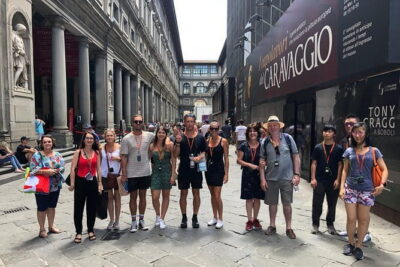
The meeting point is Via Camillo Cavour, 18, 50122 Firenze FI. The tour end is at Uffizi Galleries, Piazzale degli Uffizi, 6. That matters because you’re not bouncing around the city all day. You start near the Accademia, then you finish inside the Uffizi neighborhood.
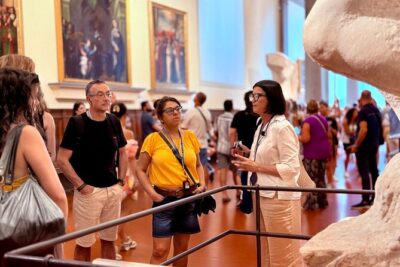
This is designed as a monolingual small group tour in English with a maximum of 15 travelers. In practice, that usually means you can hear what the guide is saying and keep moving without losing the group. When groups get larger, earphones are provided, which is a nice touch for a museum day when crowds press in.
You’ll also get a mobile ticket. That reduces the friction of paper tickets, but I still recommend you double-check you have your ID handy. For the Uffizi entry, you must present a valid passport or ID document that matches the name on your booking, and the booking requires full traveler names. If even one name doesn’t match, you can run into real problems at the museum door.
One more practical note: the Accademia start is close by, and the museum hop is short, but short does not mean effortless. You should still be ready for security lines and any short delays on very busy days.
Accademia Gallery: the Hall of Prisoners and the road to David
Accademia is where this tour starts to feel like a story instead of a sightseeing route. You head to the gallery and use skip-the-line entry so you can get inside without wasting your morning trapped in a queue.
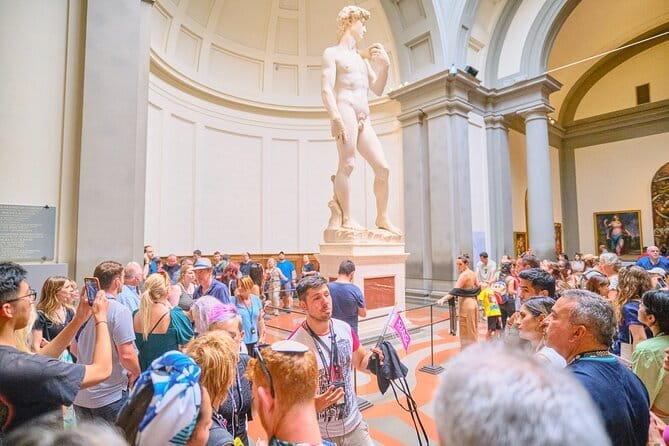
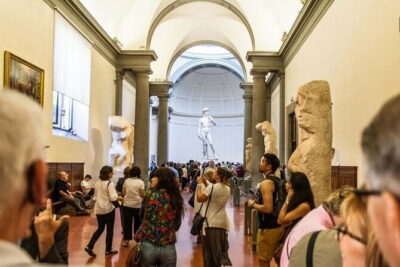
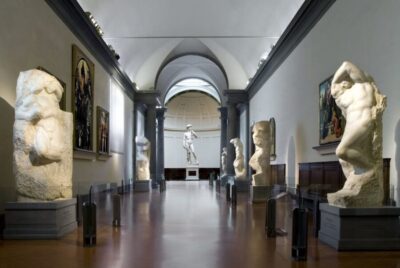
Once you’re in, your guide takes you first to the Hall of Prisoners, lined with Michelangelo’s unfinished sculptures. The key idea here is non-finito, the notion that the figures are left partially worked, which changes how you read emotion in marble. It’s not just art theory. The guide’s job is to point you toward what to look for so you can understand why these unfinished works feel so dramatic.
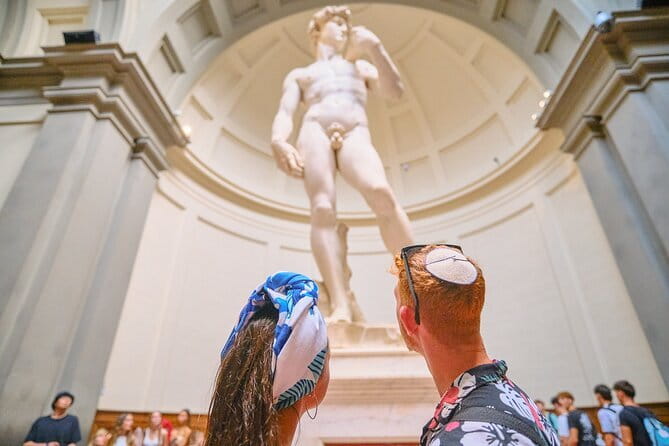
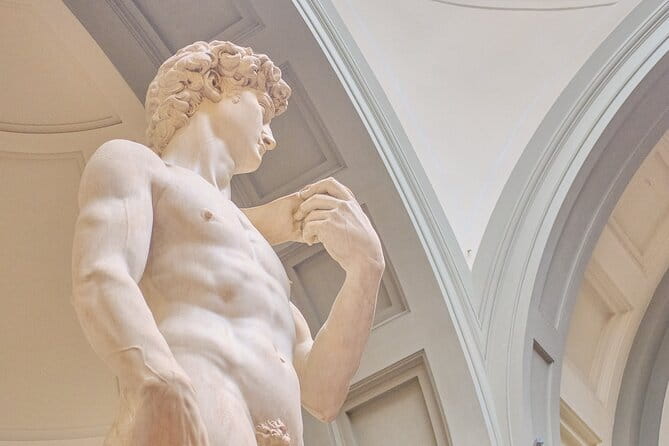
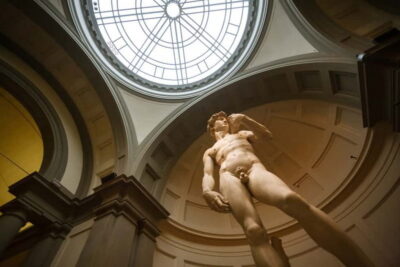
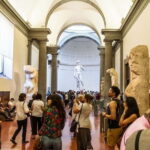
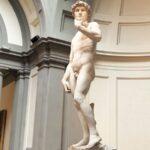
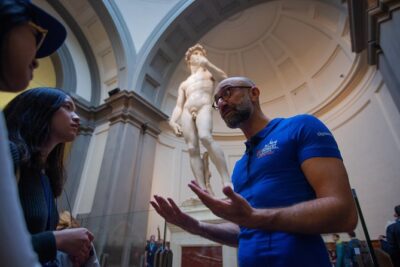
From there, you move to the moment everyone comes for: Michelangelo’s David. It’s described as more than life-size impact, around 17 feet tall, and that scale is a big part of why it’s impossible to see it casually. Your guide explains what makes it so important and adds context, including the fact that Michelangelo was only 26 when he finished it.
This stop is also where the tour balances excitement and education. You get a strong wow moment, then you get the why behind it: technique, symbolism, and Michelangelo’s life in plain language. That’s the sweet spot for most visitors who want understanding without turning the day into a textbook.
Accademia beyond David: sculptures that add depth to the day
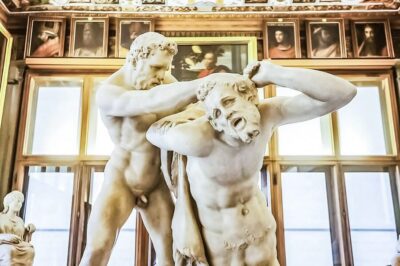
After David, the tour keeps moving so you leave Accademia with more than one headline moment. You’ll also see Rape of the Sabines by Giambologna. It’s a nice change of pace because it shows you different sculptural style and composition compared to Michelangelo’s work.
Then the guide brings you through additional works by Renaissance masters, including artists named as Sandro Botticelli, Jacopo di Cione, and Pacino di Buonaguida. Even if you only recognize a couple of names, this part helps you understand that Accademia is more than a single statue. It’s a key stop for grasping the wider ecosystem of Florentine art.
One practical consideration: Accademia is smaller than the Uffizi, so the museum can still feel crowded when groups arrive. The pacing helps, but you should still expect at least some waiting, especially if security lines are slow. Comfortable shoes really matter here because you’ll stand, look up, then shift positions to view from different angles.
Uffizi Gallery walkthrough: from Gothic starts to Botticelli and Renaissance icons
Then you jump to the Uffizi Gallery, one of the world’s most famous art museums. Your guide leads you through the galleries in chronological order, starting with the 13th century, then moving forward through the centuries. That timeline approach is more valuable than it sounds. It helps you connect how styles change, and why certain artists are seen as turning points.
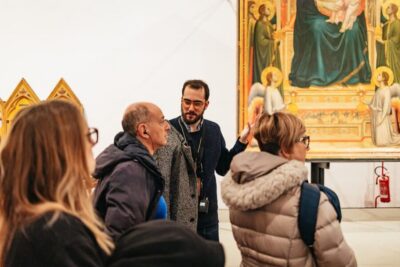
Early on, you’ll look at Gothic works that include gold-covered imagery, plus scenes of the Madonna and Child. You also get a transition point through artists tied to shifts toward Renaissance thinking, including Giotto, described here as using more three-dimensional elements.
Of course, the biggest “I knew this already but it’s still stunning” moments come later. This tour places special emphasis on the Botticelli collection, including The Birth of Venus and Primavera. If you’re the type who needs to slow down for detail, this is where you should think about using your own time at the end too, because those works deserve more than a quick glance.
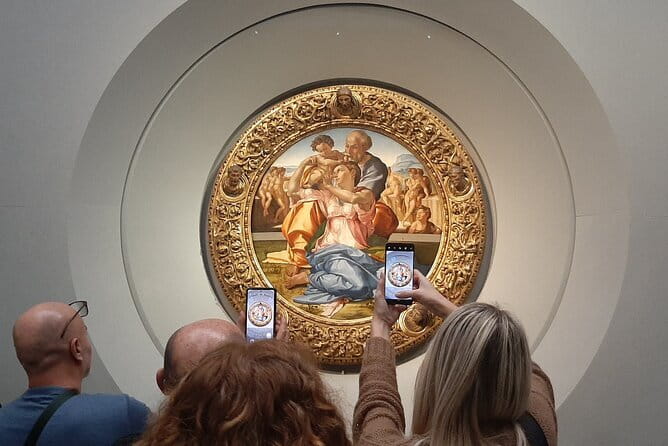
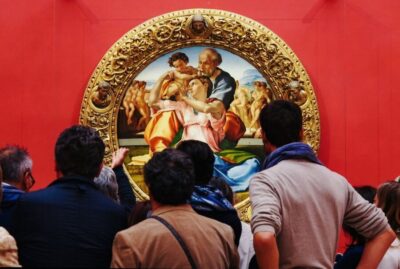
You also cover key Renaissance names mentioned for Uffizi highlights, including Leonardo da Vinci and Michelangelo. Works called out include Tondo Doni (Michelangelo), plus Baptism of Christ and The Annunciation (Leonardo da Vinci). Even when the exact painting you expect is not the one you remember, seeing the artist next to their style choices helps.
Compare the Accademia visits built around the original David
Uffizi time management: what you will likely see, and what you might miss
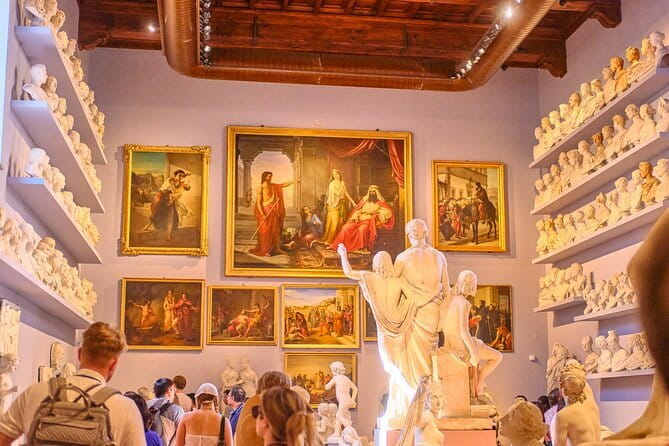
The Uffizi segment is built around a guided path through major themes and signature works, rather than a complete, floor-by-floor sweep. You’ll also hit additional named highlights, including:
- Adoration of the Magi by Gentile da Fabriano
- Battle of San Romano by Paolo Uccello
- Madonna with Child and Two Angels by Filippo Lippi
- Dukes of Urbino by Piero della Francesca
If you’re an art history fan, this approach can feel perfect because you get the connections between pieces. It’s also why Uffizi can be a little tricky for perfectionists. If you come hoping to see absolutely everything, the “best of” framing means some rooms may not make it into your guided route.
That’s where the bonus option helps. After the tour ends, you can stay inside the Uffizi as long as you like. So if the guide spent more time on one branch of the timeline, you can rebalance afterward with your own pace.
Also keep expectations realistic for time inside the Uffizi. It’s huge, and crowd flow can be slow. Even with reservations, you might still pause at security checkpoints or at moments where you’re queued into rooms. This is normal. Good shoes and a patient attitude will make the day feel smoother.
The Duomo-area walking bits: quick orientation, not a city hike
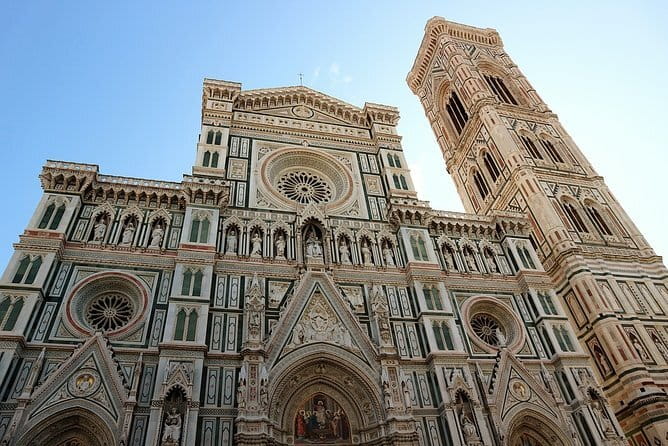
Between museum pieces, the tour includes a short walking tour of key city sights and includes a chance to view the Duomo. This is a nice “get your bearings” add-on. It helps you link what you’re seeing inside the museums to the geography outside: Florence’s center is compact, but your first day can still feel like a maze.
Because the tour includes walking segments between locations, your comfort matters. The guidance explicitly suggests comfortable shoes, and I agree. Even if distances are short, museum days involve standing around, leaning in for views, then stepping out into sun or rain.
Weather can make Florence sidewalks feel harder than you’d expect. Bring a light layer and plan for changing conditions. If it rains, you’ll still be moving, so it helps to be ready.
Value check: is this $130.97 combo a good deal?

At $130.97 per person, the headline value is that you’re buying a bundle: Accademia ticket plus reservation, Uffizi ticket plus reservation, a professional guide, and earphones for group clarity. That matters because in Florence, the most stressful part is often not the ticket price, it’s the time cost of sorting out entry while crowds surge.
You also get two layers of value built into the itinerary. First, the guide keeps the art from becoming a scatter of paintings. Second, skip-the-line access reduces the risk of your day turning into a waiting game.
There is one detail to pay attention to: the information lists Uffizi entrance as €29. Your tour includes Uffizi admission and reservation, so you’re not paying the museum separately at the gate as part of the booking experience. Still, it’s smart to remember that museum entry rules can be strict, especially around identity matching. Bring your ID and confirm names are correct.
If you’re traveling solo, the per-person price can feel steep until you price out two separate guided museum bookings plus the time you’d spend managing it yourself. If you are booking for a shared day plan, this combo usually feels efficient, because you’re paying for an all-in guided structure across the city’s top Renaissance museums.
Who should book this tour, and who should skip it
This tour is a strong fit if you want a first-time Florence museum plan that hits the hardest targets: Michelangelo at Accademia, then Botticelli and Renaissance stars at the Uffizi. It’s also a great choice if you like narrative, where a guide explains what you’re looking at while you’re in front of the artwork, not after.
It’s less ideal if your main goal is total coverage. Because the format is highlights-focused and time is limited, you might not see every floor or every piece you hoped for. One practical way to handle that: plan to use the option to stay in the Uffizi after the tour to chase your personal must-sees.
It also helps if you enjoy organized pacing. The itinerary suggests a structured chronological route in the Uffizi, and that style works best when you want to understand the big shifts between centuries rather than wander room-by-room.
Finally, this is best for travelers who can handle crowds without getting grumpy. The tour includes skip-the-line entry, but you can still hit short delays on very busy days.
Should you book this Accademia and Uffizi combo?
Yes, if you want the most important Florence Renaissance art in one afternoon and you like learning from a guide while you’re standing in the rooms. The small-group size, reserved skip-the-line setup, and the way the tour guides you from the Hall of Prisoners to David, then into the Uffizi timeline, make it feel efficient and well organized.
Think twice if you’re the type who needs to see every corner. This is not built for museum completionists. If you do book it, use your extra time after the guided portion in the Uffizi to slow down where you care most, especially around Botticelli.
FAQ
FAQ
How long is the Accademia and Uffizi combo tour?
The tour runs about 4 hours.
What is the price per person?
The price is $130.97 per person.
Are museum tickets included?
Yes. Accademia Gallery tickets and Uffizi Gallery tickets and reservations are included.
What language is the tour offered in?
The tour is offered in English.
How big is the group?
This is a monolingual small group tour with a maximum of 15 travelers.
Where do you meet the guide and where does the tour end?
You meet at Via Camillo Cavour, 18, 50122 Firenze FI, Italy. The tour ends at the Uffizi Galleries, Piazzale degli Uffizi, 6, 50122 Firenze FI, Italy.
Do I need to bring my passport or ID?
Yes. Each traveler must present a valid passport or ID document that matches the name provided at booking for successful entry to the Uffizi Gallery.
Is there earphone equipment included?
Yes. Earphones are included for bigger groups.
Can I stay in the Uffizi after the tour ends?
Yes. You can remain inside the Uffizi for as long as you would like after the tour finishes.
What should I wear or bring for comfort?
Comfortable shoes are suggested, since you’ll do walking between stops and spend time standing in museums.
Every Florence review, in one place
- Tuscany Day Trip from Florence: Siena, San Gimignano, Pisa and Lunch at a Winery
★ 5.0 · 21,634 reviews - The Best tour in Florence: Renaissance & Medici Tales – guided by a STORYTELLER
★ 5.0 · 12,316 reviews

David and the Accademia, compared
The Uffizi, another way


Florence picks that sit just beyond this itinerary
- One Hour Uffizi Guided Tour: Masterpieces of the Renaissance
★ 5.0 · 3 reviews - Sightseeing Tuscany by touring bike – 1 day rental
★ 5.0 · 3 reviews - Private Siena, S. Gimignano, Chianti Road and Wine Tasting
★ 5.0 · 3 reviews - Bargello Museum Private Tour: Michelangelo’s Bacchus & Donatello’s David
★ 5.0 · 3 reviews - Authentic Florence Cooking Class at Costanza’s 1839 Family Estate
★ 5.0 · 3 reviews - San Gimignano and Volterra private tour: etruscans, romans and middle age jewels
★ 5.0 · 3 reviews
More Uffizi Gallery Tickets & Tours worth comparing.
 ★ 4.5Skip-The-Line Uffizi Gallery Timed Entry TicketFrom $3027,832 reviews
 ★ 4.2Uffizi Priority Ticket & Masterpieces Audio AppFrom $316,402 reviews
 ★ 4.6Skip-the-Line Uffizi Small Group TourFrom $715,926 reviews
 ★ 4.5Uffizi Gallery Small Group Tour with GuideFrom $764,923 reviews
 ★ 4.5Skip the line: Uffizi and Accademia Small Group Walking TourFrom $1483,135 reviews
 ★ 4.8Uffizi Gallery and Accademia Gallery Guided TourFrom $1402,028 reviews
 ★ 4.7Uffizi Gallery Small-Group Guided Tour with TicketFrom $762,003 reviews
 ★ 4.5Michelangelo’s David, Accademia & Uffizi Small Group TourFrom $471,986 reviews
Find this experience in another shortlist