
Florence field review · MEDICI FLORENCE & RENAISSANCE STORIES
Medici Legends & Renaissance Wonders: Florence Small Group Tour
Florence hits you fast, but this tour gives it a shape. You’ll see the city’s top landmarks through the Medici family story, with a small group limited to 15 and a guide using a whisper system. I like that guides such as Manuel, Martina, Amanda, and Giacomo are often praised for turning symbols, coats of arms, and power politics into clear street-level history.
Two things I really appreciate: you get a tight introduction to Florence in about 1 hour 45 minutes, and the route keeps connecting famous places to the people who funded, designed, and controlled them. That makes it easier to plan the rest of your days. One consideration, though, is time: many stops are brief, and admission tickets for major interiors like the Laurentian Library, Medici Chapels, and Uffizi are not included.
Key highlights at a glance

- Medici-led storytelling across Florence’s most famous monuments, not random sightseeing
- Small group (max 15) for a more personal, Q and A friendly walk
- Whisper system included, helpful on windy streets and in loud squares
- Duomo complex in one pass: dome views, Baptistery, and Giotto’s Campanile
- Ponte Vecchio included at no cost for the bridge stop itself
- One big “want more” moment at Uffizi, so you can decide what to ticket next
More Medici stories behind the palaces, paintings and city streets
- The Best tour in Florence: Renaissance & Medici Tales – guided by a STORYTELLER★ 5.0 · 12,316 reviews
- The Best Tour in Florence: Renaissance and Medici Tales★ 5.0 · 10,810 reviews
- Florence: Renaissance and Medici Tales Guided Walking Tour★ 4.8 · 1,549 reviews
- Florence: Mysteries of the Medici Guided Walking Tour★ 4.4 · 940 reviews
Why this Medici lens works for first-time Florence
Florence can feel like a highlight reel. You see a dome, a palace, a square, and you move on. The trick with this tour is that it ties those moments to the Medici, the bankers-turned-rulers who used art and architecture like branding.
That “Medici lens” matters because it changes what you notice. Instead of just seeing a beautiful church, you start spotting why it was important to power. Instead of only admiring a façade, you start understanding the message behind the design choices, the patronage, and the status updates the Medici were trying to send.
You’ll also get an immediate sense of how Florence functions as a walkable city. The route moves through the market district, political squares, the Arno, and the edges of Medici residential power, all in a single afternoon start time at 12:15 pm.
Price and what you really get in 1 hour 45
At $119.77 per person for about 1 hour 45 minutes, this is not a “budget” wandering tour. But it can still be good value if you want structure and context more than museum time.
Here’s the tradeoff. The stops are designed to be short, around five minutes each, so you don’t lose the group to long ticket lines or slow interior pacing. That makes the tour a strong fit for people who want to get oriented and learn the story quickly, then come back later for deeper visits with tickets.
If you want full interiors of the Medici-related sites or the Uffizi collection itself, plan to budget separately because admission tickets are not included. The upside is that you’ll arrive at those ticketed visits with better expectations, so you spend your paid time more intentionally.
Group size, guide style, and the walk pace
The group cap is 15, which is a big deal in Florence. Smaller groups mean you’re less likely to be stuck at the back. It also helps the guide keep the story connected as you move street to street.
The tour includes a licensed guide and a whisper system, which is meant to help you hear instructions and explanations even as the city noise rises. Still, Florence streets can be loud, so if you’re sensitive to audio, it helps to stay where the guide’s voice lands best and keep your ears open during the transitions between stops.
You’ll also want to treat this like a “guided highlights” walk. Some people love that. Others prefer fewer stops with more time inside. If you’re the second type, you might still love the Medici framing, but you’ll likely want to add separate timed entries afterward.
Stop-by-stop: what to expect at each Florence Medici moment
Basilica di San Lorenzo, the Medici burial connection
Your first stop is Basilica di San Lorenzo, in the city’s main market area. This church is a big deal because it served as the burial place for principal Medici family members, from Cosimo il Vecchio to Cosimo III.
Why it’s a smart start: you’re not just learning about paintings and domes first. You’re grounding the story in family legacy and control of religious space. Even if you don’t go inside during the tour, the setting helps you understand why the Medici cared so much about who was honored, where, and how.
Note on timing and tickets: the stop is brief, and admission is not included.

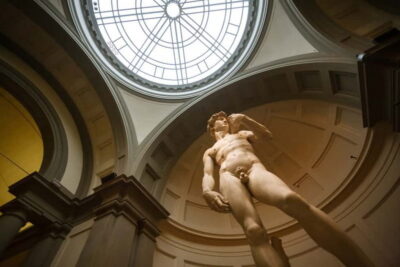
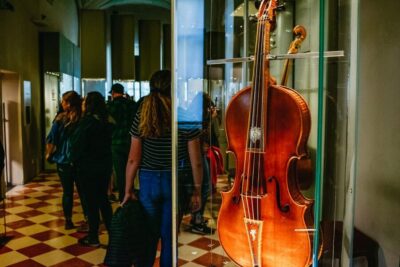
Biblioteca Medicea Laurenziana, Michelangelo’s library architecture
Next is the Biblioteca Medicea Laurenziana. This library ties directly to Medici power shifts. It was built with patronage from Medici pope Clement VII, and the goal was to signal that the Medici were more than merchants. They positioned themselves as part of an intelligent, ecclesiastical class.
It’s also known for Michelangelo’s design and for being an example of Mannerism. Even when you’re not going deep into manuscripts, this is the kind of stop that helps you see Florence as a design system. The architecture is not neutral. It’s a statement.
Again, admission tickets are not included, so your best move is to treat this stop as a story and exterior orientation, then decide later if you want to add an interior visit.
Cappelle Medicee, Michelangelo at the New Sacristy
Then you reach the Cappelle Medicee, built between the 16th and 17th centuries as extensions to Brunelleschi’s earlier church. The purpose was clear: celebrate the Medici and the Grand Dukes of Tuscany.
A standout here is the Sagrestia Nuova, also called the New Sacristy, designed by Michelangelo himself. This is where Medici storytelling becomes physical. You’re looking at the choices someone made to shape memory and status.
The caution: ticketing for interiors isn’t included, and the tour time at each stop is short. If you know you want the full experience inside the chapels, consider booking that separately after this overview walk.
Palazzo Medici Riccardi, the banking dynasty built in stone
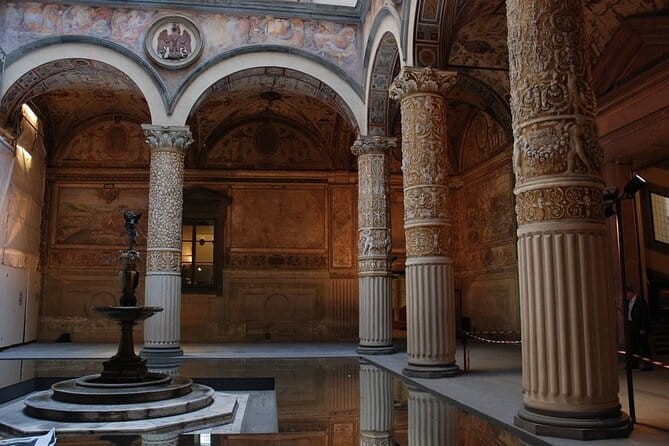
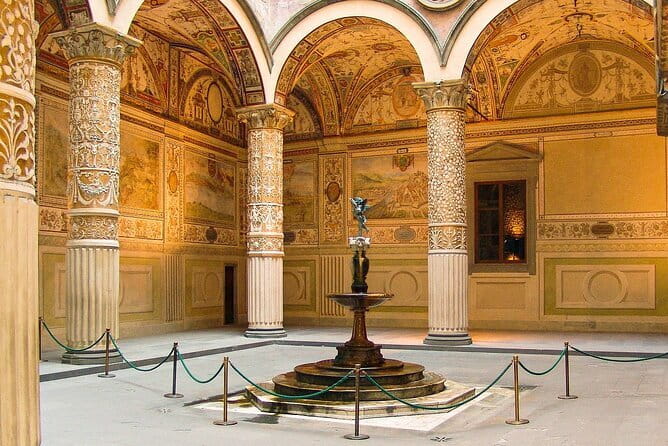
Your route also includes Palazzo Medici Riccardi, built for Cosimo de’ Medici between 1444 and 1484. This is Medici power in a form you can actually walk up to.
What I like about including a palazzo in the middle of the tour is that it prevents the story from becoming only religious or only artistic. Banking and politics are the engine behind the art patronage, and this building sits right where money turns into influence.
Admission is not included here, so plan for an outside or quick look, then revisit if you want interiors.
Duomo complex: Santa Maria del Fiore, the dome, and the old religious core
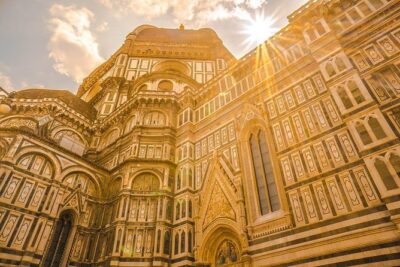
The tour then hits the Duomo complex area. You’ll see Cattedrale di Santa Maria del Fiore, known for its rich marble façade in white, green, and pink. The cathedral complex in Piazza del Duomo includes the Baptistery and Giotto’s Campanile, and it’s part of a UNESCO World Heritage Site for Florence’s historic center.
This is one of the most intense parts of the city, visually and emotionally. The dome is described in the tour as Brunelleschi’s Cupola, noted as the largest brick dome ever constructed and one of the big architectural mysteries.
You’ll also stop at the Battistero di San Giovanni (constructed between 1059 and 1128 in Florentine Romanesque style) and at Campanile di Giotto, famous for its sculptural decoration and polychrome marble encrustations.
Practical reality: you’re not doing a full interior day here. You’re doing a fast, guided “big picture” pass through the main landmarks that define Florence’s skyline and religious identity. If you want to go inside the cathedral or up for views, you’ll need separate tickets.
Palazzo Vecchio and Piazza della Signoria, civic power next to Medici power
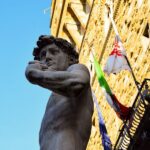
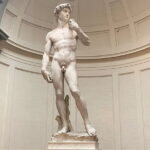
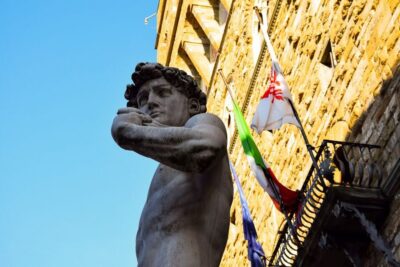
After the religious core, you shift to the political pulse at Palazzo Vecchio. This fortress-palace is the town hall and an impressive public space. The square view includes a copy of Michelangelo’s David and leads you toward the Loggia dei Lanzi with its gallery of statues.
Next is Piazza della Signoria, the L-shaped square that’s a meeting point in the city and a gateway to the Uffizi area. This is a useful stop because Florence’s story is not only about private patrons. It’s also about civic identity and public art.
The tour’s short stop time means you’ll get the context and a few key visuals, not a long linger. But it’s a great way to orient yourself so you know where you are when you later walk back on your own.
Ponte Vecchio, the bridge shops and the Arno
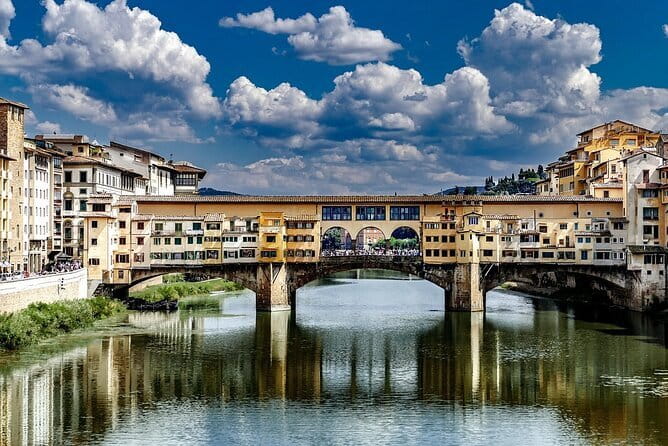
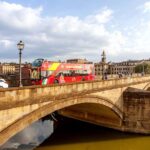
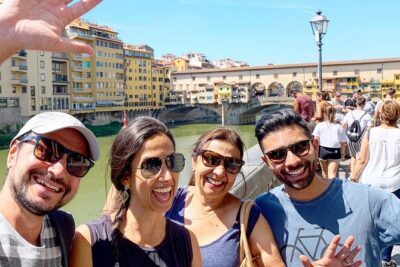
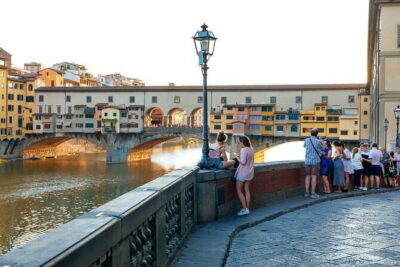
Then it’s Ponte Vecchio, the old bridge over the Arno, famous for the shops built along it. Historically, the shop occupants included butchers, tanners, and farmers. Today the tenants are jewelers and art dealers.
What makes this stop more than a postcard: it shows how Florence uses commerce and craftsmanship in a highly visible way. And it’s also included as a free stop for the bridge itself.
You’ll probably have some people around you, but this is one of those places where stopping for five minutes is enough to reset your whole mental map of the city.
Palazzo Pitti, Medici residence and the Grand Duchy
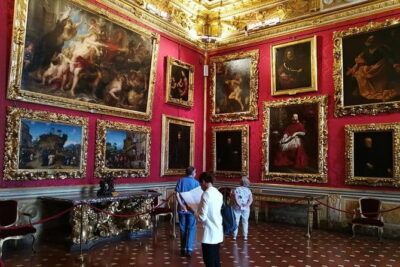
The tour includes Palazzo Pitti, purchased by the Medici in 1549 and becoming the main residence of the ruling families of the Grand Duchy of Tuscany. Over time it grew into a major treasure house as later generations collected paintings, plates, jewelry, and other luxury possessions.
This stop is a good “so what” moment. When you understand the Medici as patrons, you start seeing their impact not only in churches and libraries, but in home life, prestige, and collections.
Admission is not included, so think of this as a powerful context stop, not a full palace visit.
Uffizi Gallery, the big art promise and how to use it
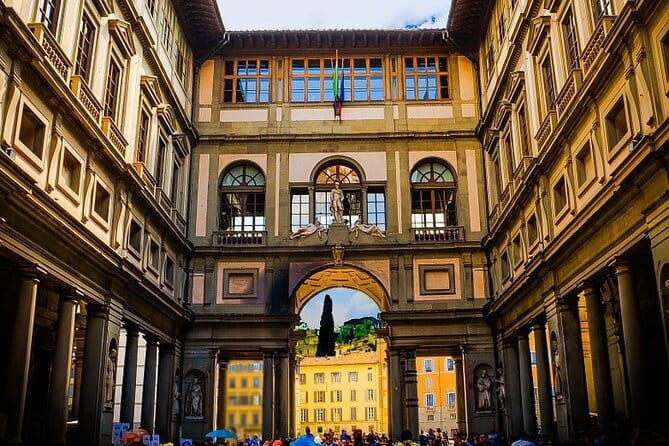
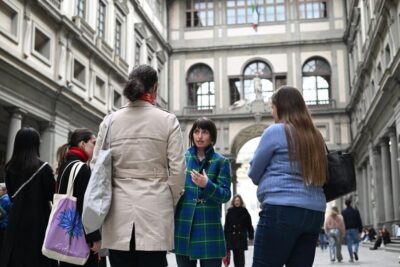
Finally, you reach Gallerie degli Uffizi. The tour frames Uffizi as one of the most visited and important museums, known for Renaissance paintings with artists like Michelangelo, Leonardo da Vinci, Raphael, and Botticelli.
One key thing to understand: the tour does not include Uffizi admission. The value of the stop is that you learn why the museum matters, then you can decide what you want from your own time inside. If you’re the type who hates museum indecision, this helps. You can picture what you’re walking into.
Also, since the tour spans from the 12th to the 16th centuries, it’s a useful anchor point for building your Renaissance timeline before you commit money and time.
The best way to plan your day after this tour
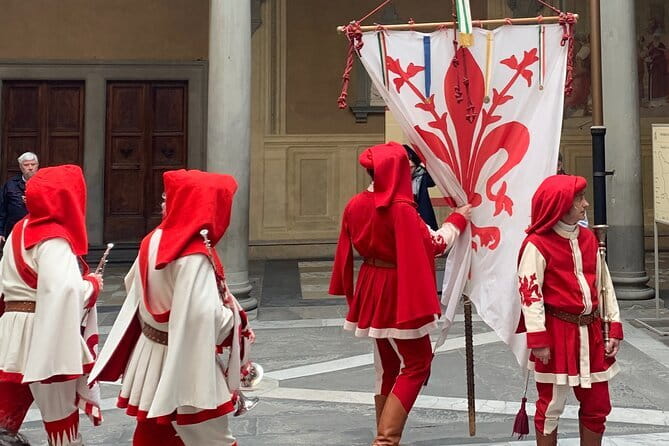
Because interiors are mostly ticketed separately, your best plan is simple: use this tour as your Florence orientation plus Medici storyline.
A smart sequence looks like this:
- Take this tour early in your trip if possible, so the city stops feeling random.
- Book any ticketed sites you care about most after, using what you learned on the walk to choose.
- Leave time later for slower exploring around the areas that made the biggest impression, especially the Duomo and the palace zones.
If you go with this strategy, you’ll feel like the paid time you spend later is more focused. You’re not just buying access. You’re buying a deeper meaning.
Who this tour is best for (and who might not love it)
This works especially well if you:
- Want a fast, guided Florence primer with a clear theme
- Like understanding why buildings exist, not just what they look like
- Prefer a small group walk over crowded, big-bus formats
It might be less ideal if you:
- Want long museum time included in the price
- Are hoping for a strictly Medici-only museum-style deep dive, with extended time inside Medici sites
Still, even if you later add Medici Palace or family-focused museum visits on your own, this tour’s strength is in connecting those places into one coherent picture of Renaissance Florence.
Should you book Medici Legends and Renaissance Wonders in Florence?
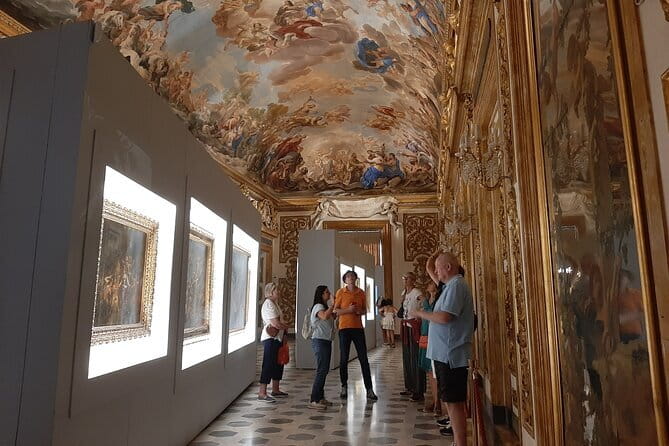
I think you should book this tour if you want a guided “get my bearings fast” introduction with strong Medici context. The small group size and whisper system help it feel more personal than the typical crowded overview. The route also hits the Florence skyline makers, the civic heart, and the Arno moment, so you leave knowing where you are and why it matters.
Pass on it if you’re mainly chasing a full ticketed museum day, because key admissions are not included and the stops are brief. In that case, you’d probably be happier with a longer, ticket-focused itinerary.
FAQ
How long is the Florence Medici Legends & Renaissance Wonders tour?
The tour is listed as about 1 hour 45 minutes.
How many people are in the group?
The group is limited to a maximum of 15 travelers.
What language is the tour offered in?
The tour is offered in English.
What is included in the tour price?
It includes a licensed tour guide, a small group experience, and a whisper system.
Are admission tickets included for stops like the Laurentian Library, Medici Chapels, and Uffizi?
No. Admission tickets are not included for the listed sites, including the Laurentian Library, Medici Chapels, and Uffizi.
Where does the tour start?
It starts at Caffè Scudieri Firenze, Piazza di San Giovanni 19R, 50123 Firenze FI, Italy at 12:15 pm.
Where does the tour end?
The tour ends at Ponte Vecchio, 50125 Firenze FI, Italy. The endpoint can vary slightly within the indicated area.
Is free cancellation available?
Yes. You can cancel up to 24 hours in advance for a full refund.
What happens if the weather is bad?
This experience requires good weather. If it is canceled due to poor weather, you will be offered a different date or a full refund.
More Florence tours to open next
- The Best tour in Florence: Renaissance & Medici Tales – guided by a STORYTELLER
★ 5.0 · 12,316 reviews
Every Florence review, in one place
- Tuscany Day Trip from Florence: Siena, San Gimignano, Pisa and Lunch at a Winery
★ 5.0 · 21,634 reviews - The Best tour in Florence: Renaissance & Medici Tales – guided by a STORYTELLER
★ 5.0 · 12,316 reviews

The Medici thread through Florence
- The Best tour in Florence: Renaissance & Medici Tales – guided by a STORYTELLER
★ 5.0 · 12,316 reviews
Florence picks that sit just beyond this itinerary
- One Hour Uffizi Guided Tour: Masterpieces of the Renaissance
★ 5.0 · 3 reviews - Sightseeing Tuscany by touring bike – 1 day rental
★ 5.0 · 3 reviews - Private Siena, S. Gimignano, Chianti Road and Wine Tasting
★ 5.0 · 3 reviews - Bargello Museum Private Tour: Michelangelo’s Bacchus & Donatello’s David
★ 5.0 · 3 reviews - Authentic Florence Cooking Class at Costanza’s 1839 Family Estate
★ 5.0 · 3 reviews - San Gimignano and Volterra private tour: etruscans, romans and middle age jewels
★ 5.0 · 3 reviews
More Medici Florence & Renaissance Stories worth comparing.
 ★ 5.0The Best tour in Florence: Renaissance & Medici Tales – guided by a STORYTELLERFrom $312,316 reviews
 ★ 5.0The Best Tour in Florence: Renaissance and Medici TalesFrom $310,810 reviews
 ★ 4.8Renaissance and Medici Tales Guided Walking TourFrom $21,549 reviews
 ★ 4.4Mysteries of the Medici Guided Walking TourFrom $31940 reviews
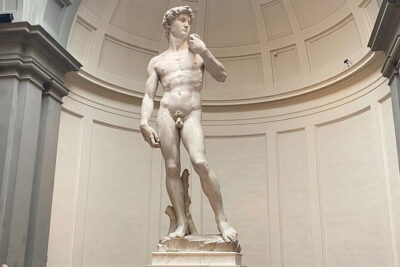 ★ 4.0Accademia Gallery: Michelangelo’s David and High Renaissance ArtFrom $43872 reviews
 ★ 4.7Guided Tour of Medici Family Secrets and ChapelsFrom $93512 reviews
 ★ 5.0Florence Private Tour: Renaissance, Famous Families & Hidden GemsFrom $199233 reviews
 ★ 4.5Pitti Palace, Palatina Gallery and the Medici: Arts and Power in Florence.From $82223 reviews
Find this experience in another shortlist