
Florence field review · UFFIZI GALLERY TICKETS & TOURS
Skip the Line: Florence’s Uffizi Gallery Guided Tour
One ticket, one plan, and suddenly the Uffizi feels manageable. This skip-the-line guided tour cuts through the worst of the waiting, then uses a small-group route to show you the works that define Florentine Renaissance art.
What I like most is that you get a fully licensed guide in your ear from the moment you enter, not just a self-guided shuffle. And the pacing is built around art history in order, from earlier Renaissance ideas through the big names like Botticelli, Leonardo, and Michelangelo.
One thing to consider: this is about 1 hour 45 minutes, so you will not see everything. You get a smart highlight route, but if you want every single room, you will need extra time after the tour.
Key things to know before you go
- Skip-the-line entry helps you start inside without getting stuck at ticket lines
- Small groups (max 9) make it easier to hear your guide and ask questions
- Audio headsets/earphones are included, which really matters in a crowded museum
- Chronological route moves through the Uffizi’s story from the 13th century onward
- Your guide points out the big must-sees, including Botticelli, Leonardo, and Michelangelo
- You can stay after the tour, so this works as both an intro and a warm-up for deeper exploring
More ways through the Uffizi, with the queue and guide choice made clear
- Florence: Skip-The-Line Uffizi Gallery Timed Entry Ticket★ 4.5 · 27,832 reviews
- Florence: Uffizi Priority Ticket & Masterpieces Audio App★ 4.2 · 6,402 reviews
- Florence: Skip-the-Line Uffizi Small Group Tour★ 4.6 · 5,926 reviews
- Uffizi Gallery Small Group Tour with Guide★ 4.5 · 4,923 reviews
Skip-the-line value at the Uffizi, and why it matters
The Uffizi is one of those places where timing can make or break your mood. The building draws crowds, and ticket lines can eat up the best part of your day. This tour’s main promise is simple: you bypass the bottleneck and go straight inside with your skip-the-line access.
That matters because your guide is only with you for a set amount of time (about 1 hour 45 minutes). If you lose time in a line, you end up with less art and more wandering. With the skip-the-line entry, you start your museum visit already in motion, and you get to use that time on paintings and sculptures you actually care about.
The other “value” is that you are not staring at masterpieces without context. In a museum this big, it is easy to feel like you are just walking from one crowd cluster to another. A guide turns the chaos into a route with a point.
Meeting at Via Cavour, then walking to the entrance like a local
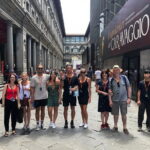
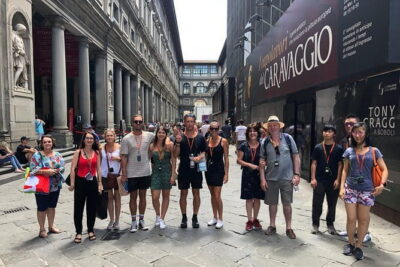
You meet at Co Re ComVia Camillo Cavour, 18, 50122 Firenze FI. From there, you follow the guide toward the Uffizi, about a 15-minute walk, and then you enter together using the skip-the-line ticket.
I like this approach because it gives you a short buffer to settle in. You are not immediately trapped inside the museum right as you feel rushed. Also, the walk helps you get oriented in Florence, which pays off once you realize you will spend time moving through corridors and rooms with different levels of light and crowd flow.
The tour ends inside the Uffizi Galleries, near Piazzale degli Uffizi, 6, 50122 Firenze FI. That is convenient if you plan to keep exploring on your own right away, since you do not have to backtrack to find an exit.
Practical tip: wear comfortable walking shoes. The Uffizi is not a sit-and-sip kind of visit.
Your guided route: 13th to 18th century without getting lost
This is a structured visit, built to move through centuries in order. Your guide leads you through “luxurious halls and rooms” with a chronological flow, so you see how styles shift over time, instead of bouncing randomly from one famous painting to the next.
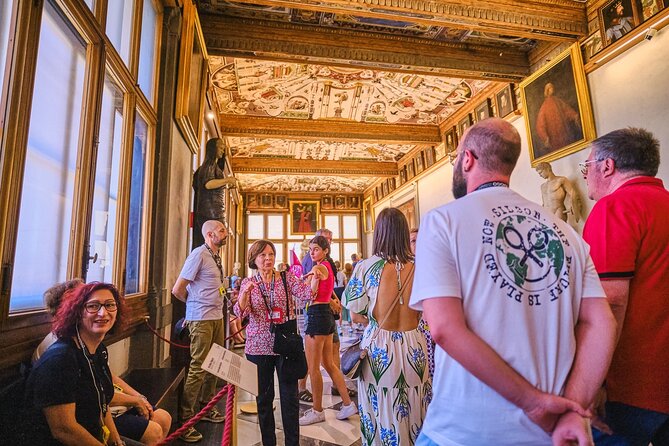
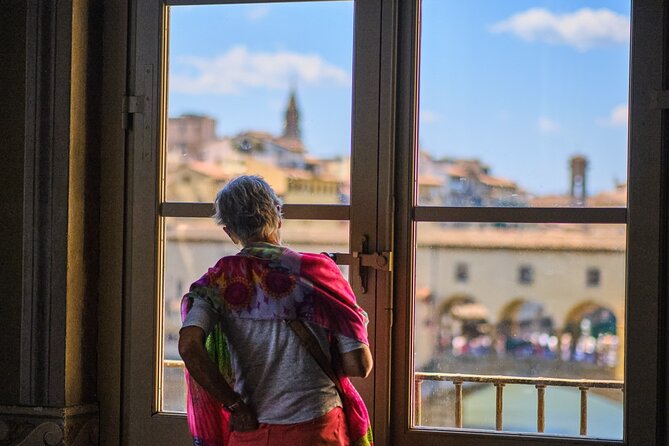
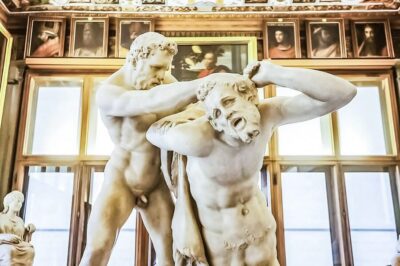
Along the way, you are not just staring at paintings on walls. You also get brief looks at Roman and Greek sculptures, and you notice the frescoed ceilings and the museum’s window views over Florence’s city center. Those little moments help break up long stretches of art and crowd noise.
Time-wise, the tour segments are roughly balanced across the main stops. The route feels like an introduction with enough depth to make you want to return later for slower viewing.
Stop-by-stop: what you’ll see and what to watch for
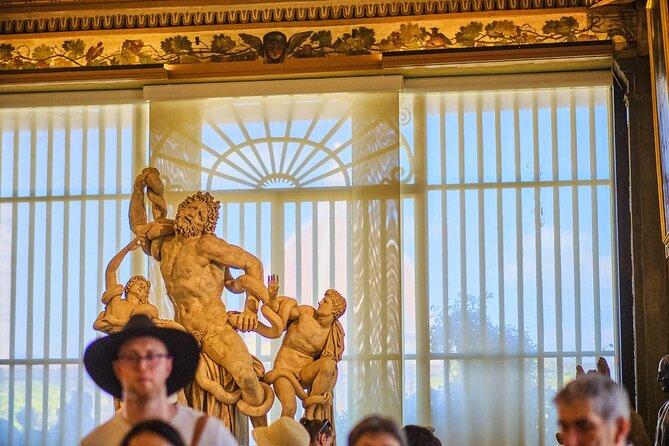
The first galleries: early Renaissance signals and a sense of style change
Early on, your guide focuses on the Uffizi’s earlier foundations, starting in the 13th century and moving forward. This is where you can spot how art starts to use more depth and more believable space.
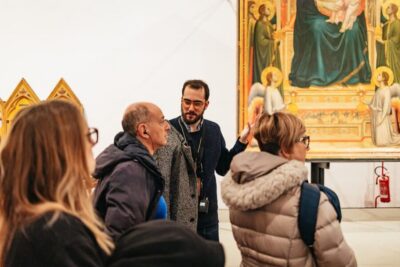
One of the breakout themes is religious imagery, including works with gold backgrounds that feature Madonna and Child. Then you get a turning point with Giotto, where the style shifts toward more three-dimensional effects. Even if you are not an art-history person, this helps you understand why people get excited about these artists. It is not just about fame, it is about technique and change.
Why this stop is worth it: if you skip the early parts, Botticelli and Leonardo can feel like they appear out of nowhere. Seeing the build-up makes the later masterpieces make more sense.
A drawback at this stage: because it is a highlight tour, you will likely spend less time at any one painting than you would in a self-guided visit.
When a guide is worth having beside you in Florence
International Gothic and the art of storytelling
Next comes the International Gothic period, with works that emphasize emotion and narrative. Your guide points out major pieces such as Gentile da Fabriano’s Adoration of the Magi and explains how art began to tell a story rather than just depict figures.
This is also where you can start noticing composition choices. You begin to see how artists guide your eye across a scene, and how details like gestures, facial expressions, and spatial layout communicate the plot.
What I’d do if you are the type who likes to re-look: after your guided explanation, pause for a minute before you move on. Even one quiet minute can turn a “seen it” painting into a painting you actually remember.
The 1400s breakthroughs: experiments in space and faces
Your route continues into the 1400s, when artists experiment more actively with three-dimensional space and idealized features. You stop at key works like Paolo Uccello’s Battle of San Romano, which shows that push toward depth and perspective.
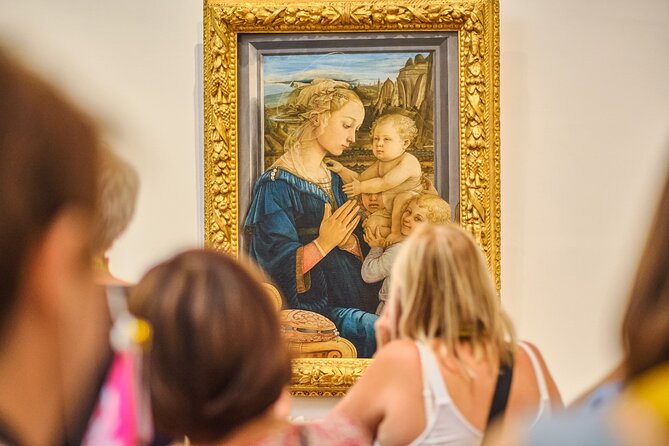
Then you move through works by artists such as Filippo Lippi (including Madonna with Child and Two Angels) and Piero della Francesca, including Dukes of Urbino. The guide ties these shifts to later influence, including artists you will recognize from high Renaissance art.
Here is the practical payoff: once you understand these experiments, you will look at Leonardo and Michelangelo differently. You will not just admire skill, you will notice how the earlier ideas led to later mastery.
Botticelli and the core Florentine mythology
If you care about the big museum names, this portion matters. Botticelli is a major focus in the Uffizi, and your guide spends time on his most famous work, including The Birth of Venus and Primavera.
You also learn about Botticelli’s connection to the Medici family, which helps explain why these works were made and why they mattered to the people funding and shaping art in Florence.
From a visitor standpoint, this is one of the best “return on time” sections of the tour because the Uffizi can be overwhelming at first. Having a guide tell you what to pay attention to means you can enjoy the painting instead of hunting for where to look.
Tip: this is also a section where crowds form quickly. Listen to your guide for a short moment, then take your own glance right after, so the explanation and your eyes work together.
Leonardo and Michelangelo close up, plus the feeling of being near the classics
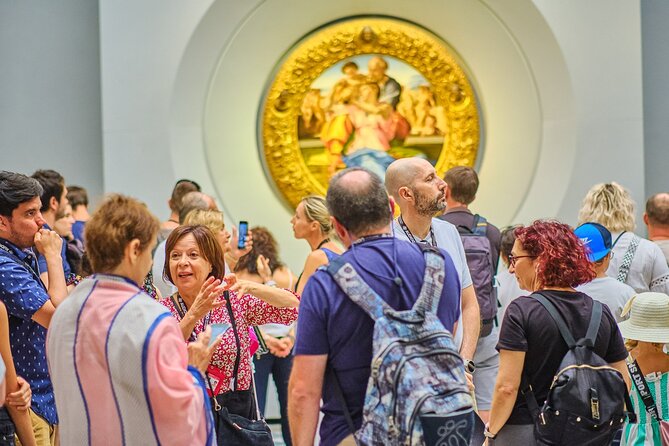
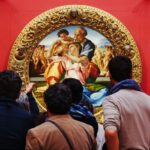
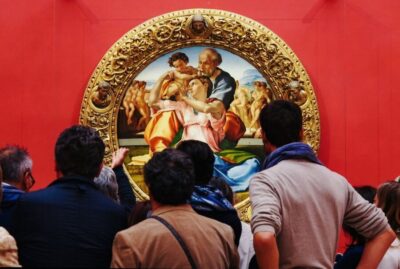
Your guide brings you into Leonardo da Vinci works such as Baptism of Christ and The Annunciation, and to Michelangelo’s Tondo Doni. The Uffizi is not always the top “bucket list” location for Leonardo and Michelangelo in the way some other sites are, but the emotional factor of seeing them in person is still huge.
The value here is interpretation. You get clearer context for what you are seeing, which helps you separate surface beauty from deeper meaning. Even if these specific Uffizi examples are not your top two museum choices, your guide’s framing makes them feel like part of a larger Renaissance conversation.
Big halls at the end: Raphael, Titan, and Caravaggio style shock
Your last segment moves you through three large halls with many works, including artists like Raphael, Titian, and Caravaggio. This is the part where styles can feel like they jump. One artist’s calm order contrasts with another’s dramatic realism or shifting atmosphere.
Your guide also encourages questions here, which is useful because by this stage you usually know what you care about. Maybe you want to understand symbolism. Maybe you want to know why a painting looks the way it looks. Either way, asking mid-tour helps you connect what you are seeing with your own interests.
Important reality check: this end portion is a lot of art in a short span. You will not catch everything. The win is that you see where to go next on your own after the tour.
Earphones, group size, and the one thing that can affect your enjoyment
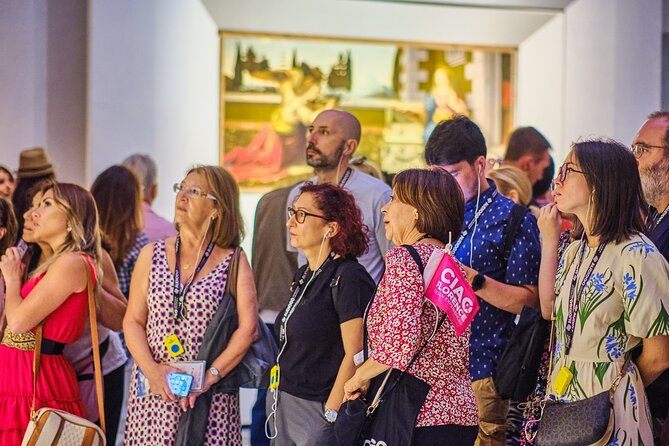
This tour runs with a maximum of 9 travelers, which is a sweet spot for group tours. Small groups generally mean less time spent waiting and more chance to hear instructions.
Earphones are provided for bigger groups, and you also receive an audio headset setup designed to help you hear your guide clearly. In a crowded museum, this is not a small detail. It can change the entire experience from frustrating to smooth.
One note from real-world experience with tours like this: guide accents and clarity can vary. If you have trouble hearing strong accents, the headset helps, but it is still worth it to plan around noise, especially during peak hours. The museum is crowded by design.
Also, on busiest days you may see some short delays at the entrance into the museums. The key point is that your skip-the-line access is meant to reduce the pain, not promise a total lack of waiting under any circumstance.
Price and timing: is $58.52 a good deal?
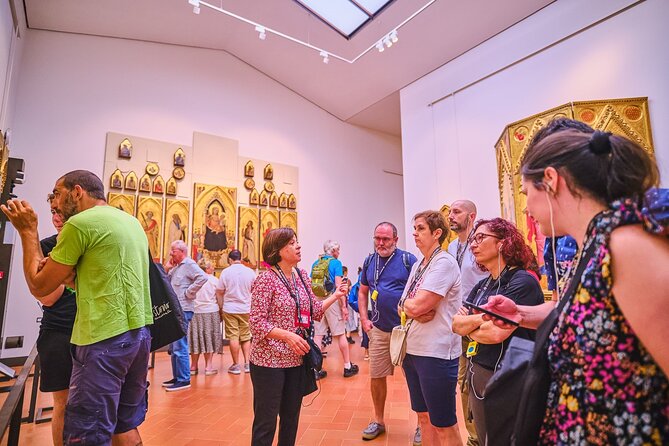
At $58.52 per person, this is not a bargain-basement museum add-on. But you are paying for three things that are hard to replicate on your own: skip-the-line entry, a fully guided route with a licensed guide, and audio support.
Think about the alternative. If you buy tickets and try to build your own route, you spend time deciding what to see. In the Uffizi, time spent choosing is time not spent looking. A guided tour compresses planning into a pre-made path.
Timing also helps. This tour is often booked about 41 days in advance on average, which is a sign that it is popular and that good times can fill up. If your schedule is fixed, earlier booking is a smart way to avoid getting stuck with less ideal time slots.
For value, I also like that you can stay after the guided portion. The tour acts like a map and a shortlist. After that, you can spend your extra museum time exactly where your interests point.
Who this tour suits best
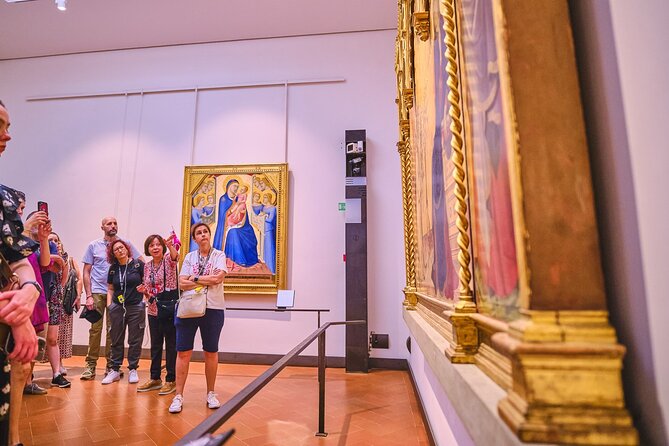
This is a strong match if you want:
- A high-impact intro to the Uffizi in under two hours
- A guided path through major artists and key works like The Birth of Venus and Tondo Doni
- A group size that stays small enough to keep things moving
It is less ideal if you:
- Want to read every label and take hours on one painting
- Plan to spend the whole day inside without any structure
- Need a very flexible, room-by-room choice during the guided portion
If you are coming for the first time, this tour often helps you avoid the common mistake of seeing only crowd magnets. If you are returning, it can refresh your memory and point out what to prioritize next.
After the tour: how to use the extra time inside the Uffizi
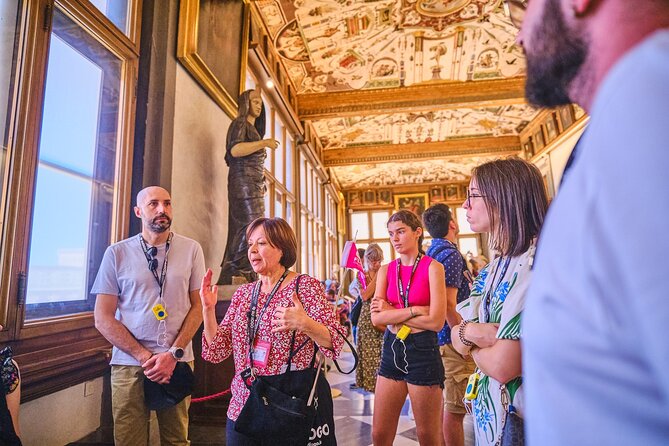
The best feature here is that you are not cut loose into the museum with no plan. After the guided tour ends, you are free to keep exploring at your own pace.
So do this: pick one or two artists your guide highlighted and spend real time there. You will recognize more details because you already heard the historical context. Then walk through at a slower speed and look for the window views over Florence when you want a break from indoor walls.
If you only do one thing after the tour, make it this: go back to at least one major painting and look again. The second look usually hits harder after you know what to look for.
Should you book the Skip-the-Line Uffizi guided tour?
I would book this if you want an efficient, guided way to tackle one of the world’s most famous art museums without losing time to lines. The skip-the-line entry, small group size, and audio headsets make it practical, not just romantic.
I would think twice if you are the kind of visitor who plans to spend most of the day in the Uffizi and wants total freedom during the guided portion. This tour is a smart highlight route, not a full museum marathon.
If you can, aim for an early slot when possible. Even with skip-the-line access, peak hours can still feel packed once you are inside. Early timing gives you calmer viewing and a better chance to actually absorb what you came for.
FAQ
How long is the Uffizi skip-the-line guided tour?
The guided tour lasts about 1 hour 45 minutes.
Does the tour include skip-the-line admission?
Yes. You get a skip-the-line entrance ticket to the Uffizi Gallery.
What’s included in the tour price?
You get a professional guide, skip-the-line admission, and earphones for bigger groups. The tour also provides audio support for hearing the guide clearly, and entrance fees are included.
Where do I meet, and where does the tour end?
You meet at Co Re ComVia Camillo Cavour, 18, 50122 Firenze FI, Italy. The tour ends inside the Uffizi Gallery at Piazzale degli Uffizi, 6, 50122 Firenze FI, Italy.
What languages are available for the tour?
From November to March, the tour is always confirmed in English and Spanish. From April to October, the tour will be held in a monolingual small group. For Italian, French, and German, the minimum required is 4 pax.
Are there any health or entry requirements for participants over 12?
Yes. Participants over 12 must present one of the following: proof of full vaccination, proof of first vaccination administered at least 15 days ago, proof of a Covid-19 infection in the past 6 months, or a negative test taken no more than 48 hours before the activity starts.
More Florence tours to open next
- The Best tour in Florence: Renaissance & Medici Tales – guided by a STORYTELLER
★ 5.0 · 12,316 reviews



Every Florence review, in one place
- Tuscany Day Trip from Florence: Siena, San Gimignano, Pisa and Lunch at a Winery
★ 5.0 · 21,634 reviews - The Best tour in Florence: Renaissance & Medici Tales – guided by a STORYTELLER
★ 5.0 · 12,316 reviews

The Uffizi, another way
Florence picks that sit just beyond this itinerary
- One Hour Uffizi Guided Tour: Masterpieces of the Renaissance
★ 5.0 · 3 reviews - Sightseeing Tuscany by touring bike – 1 day rental
★ 5.0 · 3 reviews - Private Siena, S. Gimignano, Chianti Road and Wine Tasting
★ 5.0 · 3 reviews - Bargello Museum Private Tour: Michelangelo’s Bacchus & Donatello’s David
★ 5.0 · 3 reviews - Authentic Florence Cooking Class at Costanza’s 1839 Family Estate
★ 5.0 · 3 reviews - San Gimignano and Volterra private tour: etruscans, romans and middle age jewels
★ 5.0 · 3 reviews
More Uffizi Gallery Tickets & Tours worth comparing.
 ★ 4.5Skip-The-Line Uffizi Gallery Timed Entry TicketFrom $3027,832 reviews
 ★ 4.2Uffizi Priority Ticket & Masterpieces Audio AppFrom $316,402 reviews
 ★ 4.6Skip-the-Line Uffizi Small Group TourFrom $715,926 reviews
 ★ 4.5Uffizi Gallery Small Group Tour with GuideFrom $764,923 reviews
 ★ 4.5Skip the line: Uffizi and Accademia Small Group Walking TourFrom $1483,135 reviews
 ★ 4.8Uffizi Gallery and Accademia Gallery Guided TourFrom $1402,028 reviews
 ★ 4.7Uffizi Gallery Small-Group Guided Tour with TicketFrom $762,003 reviews
 ★ 4.5Michelangelo’s David, Accademia & Uffizi Small Group TourFrom $471,986 reviews
Find this experience in another shortlist