
Florence field review · WALKING TOURS
Essential Florence Walking Tour with an Expert Local Guide
Florence clicks faster when you have a guide who connects the dots. This 3-hour, guided walking tour strings together major landmarks and smaller stories, from Dante’s home area to Medici power and Renaissance architecture, with time to stop, ask questions, and grab a quick break. I like that it feels efficient without feeling rushed, and you get a local lens on why these places matter.
I also like the practical pace: the route is built for real sightseeing on foot, including plenty of bathroom breaks and a gelato stop as you wander cobblestones. One consideration: it is still a walking tour through central Florence, so if you are sensitive to hills or crowds, bring your best walking shoes and plan on a steady stroll for the full duration.
Key reasons this tour works well

- A tight 3-hour loop that helps you orient fast, especially if it is your first day in Florence
- Expert local storytelling that links places to Medici politics, guild life, and major architectural changes
- Many free-entry stops along the route, so your money goes to the guide and not ticket lines
- Gelato built into the walk so the tour includes a real-life Florentine moment
- Small-group feel (max 20), with reports that groups can be much smaller in practice
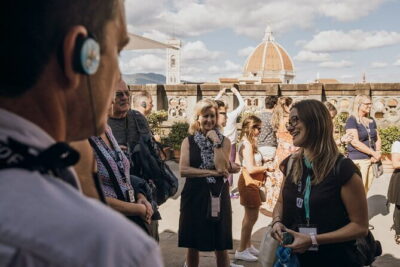
- Listening support mentioned in reviews, including headpieces called out as helpful in busy areas
Florence walks that make the stone streets tell the story
- Florence: Guided Walking Tour★ 4.5 · 3,334 reviews
- Skip the line: Uffizi and Accademia Small Group Walking Tour★ 4.5 · 3,135 reviews
- Florence: Guided Walking Tour★ 4.6 · 1,602 reviews
- Florence: Renaissance and Medici Tales Guided Walking Tour★ 4.8 · 1,549 reviews
The value of doing Florence with a real storyline
Florence can feel like a giant open-air museum. The catch is that you can stare at beautiful facades all day and still miss the “why.” This tour is designed to supply the missing context, moving from one key site to the next while explaining what was happening politically, economically, and artistically.
You also get a practical win: you are not spending your trip time figuring out routes between the Duomo area and the Oltrarno side of the city. The tour is structured so you cover the most famous sights plus a few architectural gems that are easy to overlook when you travel on your own.
The price, at $40.12 per person, is a big part of what makes it feel fair. You are paying for guided access and interpretation across multiple landmarks, and many of the stops are marked as admission ticket free. In other words, you are not doubling your costs with a stack of paid attractions.
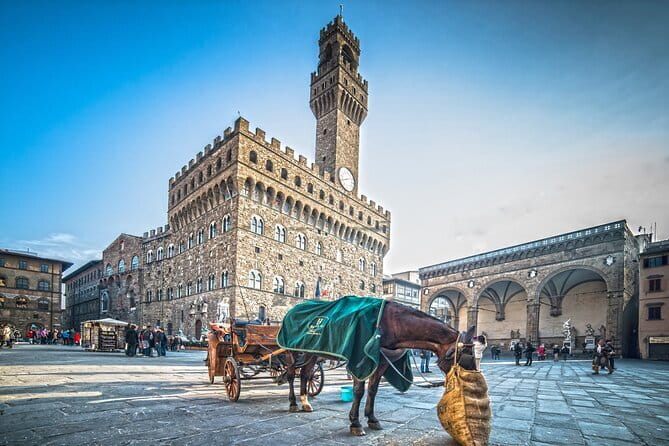
Meeting at Piazza della Repubblica, ending by Piazza della Signoria
The tour starts in Piazza della Repubblica at 9:00 am and ends in Piazza della Signoria. That start point is convenient for most first-time arrivals because it is in the thick of central Florence, close to lots of public transport options.
Ending near Piazza della Signoria is also smart. After 3 hours of walking and storytelling, you land right where you can keep exploring without backtracking. You can roll straight into more sights in the same area, grab lunch, or start mapping the rest of your Florence days with a clearer sense of direction.
One logistical note I think you will appreciate: it is a mobile ticket. That means less paper, fewer last-minute hassles, and fewer things to misplace before you meet your guide.
Orsanmichele and the guilds: where Florence’s power met art
The tour begins with Orsanmichele, a church and museum in the center of Florence. You start with something that looks like a church from the outside, but historically it began as a loggia used for storing and trading grain. Later, it shifted into an “arts church” tied to the ancient Florentine guilds.
That transformation is the kind of detail that changes how you see the building. Instead of treating Orsanmichele as just another stop on a list, you understand it as a place where commerce and civic pride literally became art commissions.
Inside the upper floors, the museum includes originals connected to the sculptural cycle on the building’s external niches. You also hear about famous works, including statues attributed to Donatello and Ghiberti. Even if you do not consider yourself an art expert, this is a good grounding moment because it introduces the idea that Renaissance Florence was powered by organizations, money, and ambition, not just genius in isolation.
Practical benefit: Orsanmichele is also a useful entry into the walking rhythm. You get the first “big context” story early, which helps the rest of the day make more sense.
Dante’s neighborhood: Casa di Dante without the tourist fog
Next up is the Museo Casa di Dante. Even if you already read Dante in school, Florence feels different when you connect the poet to the street-level reality of his city.
The tour focuses on Dante’s life and work, and it also helps you understand the city that shaped him. One advantage here is that you are not just pointed at a plaque. You are given enough story to connect names, places, and historical meaning.
If you tend to zone out during museum-style stops, this one is still likely to keep your attention because it is framed as a life in a specific place, not a random collection of facts.
Duomo day in miniature: Santa Maria del Fiore, roots, and the dome
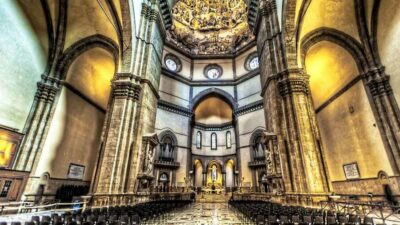
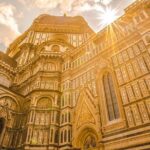
No Florence walk is complete without the Duomo, and this one puts you right at the heart of it: Cattedrale di Santa Maria del Fiore, Florence’s cathedral symbol. The guide’s explanation includes why it was such a big deal when completed in the 15th century, including its status as the largest church in the world at the time.
You also get the “engineering pride” angle. The dome is still presented as the absolute primacy of the largest masonry dome. That matters because it explains why people built and planned on such an enormous scale, and why Florence felt like it was competing in the biggest league.
Another detail I appreciated conceptually, even if you are not a architecture nerd: the cathedral stands on foundations of earlier worship sites, including Santa Reparata, and there have been buildings of worship here since Roman times. That continuity helps you see the Duomo as part of a long story, not just a single masterpiece dropped into the skyline.
When a guide is worth having beside you in Florence
Baptistery of St. John: baptism, knights, and poets
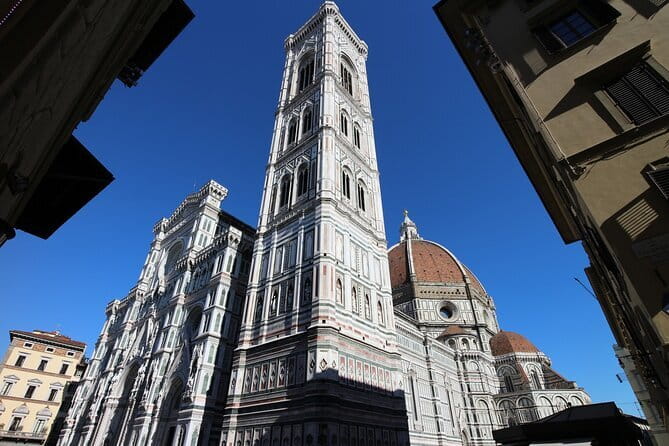
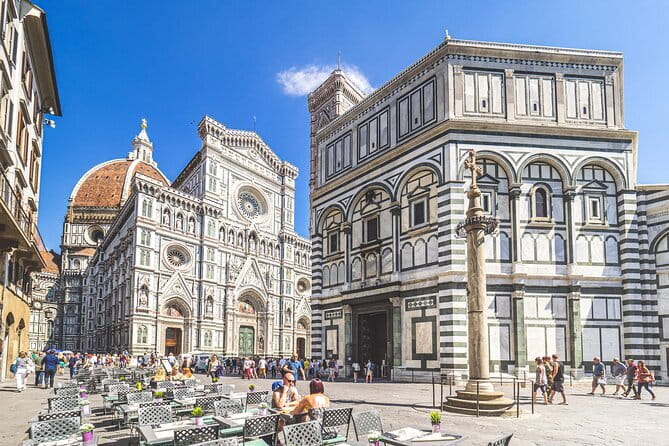
Across the square, you move to the Baptistery of St. John, dedicated to the city’s patron saint. This is the kind of stop that is more interesting with context because its role goes beyond religious architecture.
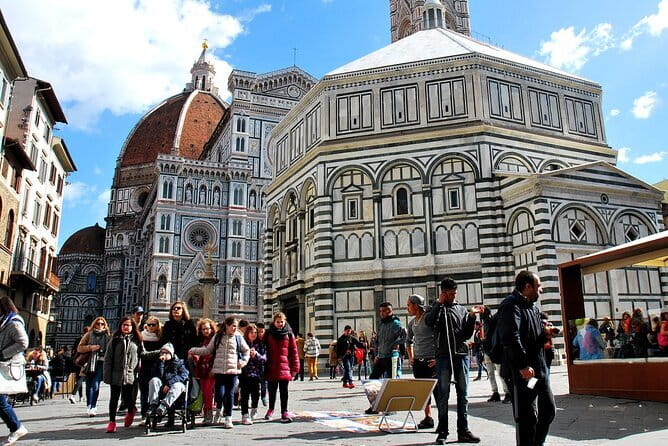
For centuries, this baptistery was where Florentines received baptism. It was also described as a place tied to investiture of knights and poets, including Dante, who was also baptized here. So when you look at it, you start thinking about it as a civic stage. People did not just visit. They were shaped, recognized, and celebrated here.
If you like tours that explain why a place matters socially, this stop will land well.
Giotto’s Campanile: seeing the same skyline, with better reasons
Then the tour shifts to Giotto’s bell tower, Campanile di Giotto, which is the bell tower for the cathedral complex and located in Piazza del Duomo.
Bell towers in Italy are often more than clocks. They are landmarks, civic signals, and visual markers of where power and religion overlap. Having the guide connect the bell tower to the cathedral helps you build a mental map fast.
Also, being in Piazza del Duomo for this portion of the walk is simply efficient. You are getting multiple skyline-defining sights close together, so you do not burn time crossing the city just to view the next big thing.
Santa Maria Novella to the Renaissance palaces: power made decorative
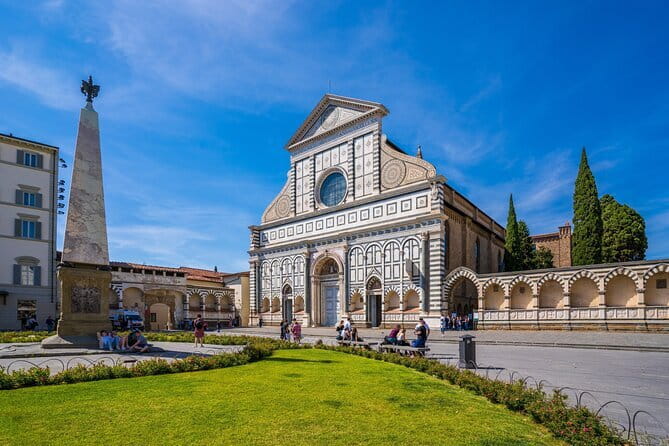
From there, the tour moves toward Santa Maria Novella, a basilica on the square of the same name. You get a quick explanation of its importance to the Dominican order, which used it as a point of reference.
This stop matters because it anchors Florence’s religious landscape in real institutional life. It also helps you contrast how different organizations shaped the city, from guilds at Orsanmichele to mendicant orders here.
Then you head into the world of Renaissance palaces, starting with Palazzo Rucellai. The facade gets attention for its Renaissance architectural ideas, particularly the use of pilasters and entablatures in proportional relationship. The guide’s explanation includes the believed design by Leon Battista Alberti for Giovanni di Paolo Rucellai (with execution in part by Bernardo Rossellino). If you normally walk past palaces without noticing details, this is the kind of guided framing that makes the facade feel like a solved puzzle.
Palazzo Strozzi is next, and it comes with a dramatic backstory. It was built after destroying 15 buildings to make room. The palace is described as one of the best-known Renaissance palaces, and its three identical portals on every side are highlighted.
If you are the type who loves architecture but hates reading long plaques, this portion is a sweet spot. You are guided toward what to look at and why it was designed that way.
Santa Trinita, frescoes, and the Oltrarno shift
Once you cross into the Oltrarno feel of Florence, the tour starts to feel less like “top sights” and more like “this is how the city lives.” Basilica di Santa Trinita is one example, where the guide brings you inside to see frescoes by Ghirlandaio.
Going inside matters here. Outdoor stops can blur together, but interior art forces you to slow down for a moment. Even a short time in a church can change how you understand the city because the art and religious setting work together.
Palazzo Pitti: Medici residences and the way Florence changed hands
The tour continues to Palazzo Pitti, an imposing Renaissance palace a short distance from Ponte Vecchio in Oltrarno. Here you get the political timeline of Florence in palace form.
The original nucleus dates back to 1458, when it was a residence for banker Luca Pitti. In 1549, the Medici family purchased it, and it became the main residence of the grand dukes of Tuscany, first under the Medici and later connected to Habsburg-Lorraine. After Italian unification, it also played the role of a royal palace for the House of Savoy during Florence’s brief stint as the capital of the Kingdom of Italy (1865 to 1870).
That chain of ownership gives you a clear mental story. Florence was not frozen in time. It changed rulers and political systems, and this palace tracked those shifts.
Santa Felicita: a calmer stop between Ponte Vecchio and Pitti
Church of Santa Felicita comes next. It is located in the Oltrarno district, between Ponte Vecchio and Palazzo Pitti, and is described as one of the oldest churches in Florence.
This stop can feel like a reset after palaces and grand political stories. Instead of focusing on scale and power alone, you get a sense of longevity, of Florence’s religious core surviving across centuries.
The Vasari Corridor: why it was built to move safely
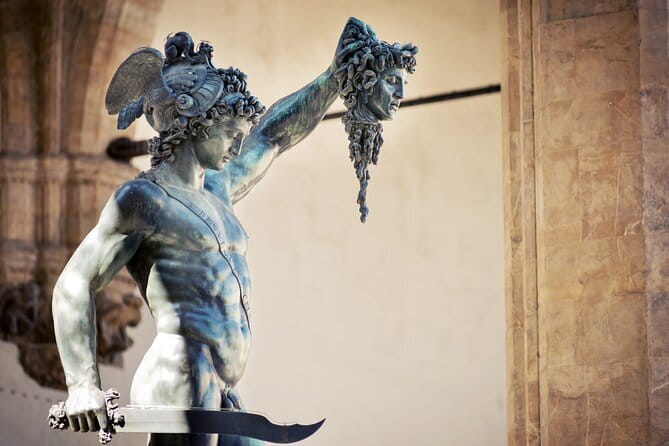
Finally, the tour includes the Vasari Corridor, an elevated path connecting Palazzo Vecchio with Palazzo Pitti. The guide explains that it passes through the Uffizi and over Ponte Vecchio.
The most useful piece of context is the motive: the corridor was designed to let the grand dukes move freely and without danger from their residence to the government palace. The reasoning given is that support for the new duke and the new government system was still uncertain after the ancient Florentine Republic.
That detail makes the “bridge in the air” idea feel less fanciful. You understand it as a response to fear, control, and public instability, not just an architectural flex.
What you should expect during the 3-hour pace
This is built as a compact tour. You are moving between major sights and key in-between points, but you are not sprinting. Highlights include plenty of time for bathroom breaks, which is a real quality-of-life factor in Florence. The cobblestones and crowding can make even a short walk feel longer than expected, so these built-in pauses help you stay comfortable.
Also, wear comfy walking shoes. You will want something supportive and reliable on uneven streets and stone steps. Even if you are in decent shape, Florence punishes bad shoes.
Group size is capped at 20 travelers, and multiple reviews describe small groups in practice, including around 10 people. That matters because smaller groups help you hear your guide better and ask questions without feeling like you are yelling into a crowd.
Guides, style, and what reviews consistently point to
The guide experience is a major part of why this tour earns such strong ratings. The most repeated praise in reviews points to storytelling plus real professional handling of the group. Names like Andrea and Becky show up often, and Lisa is also mentioned as a standout guide who can work with adults and children.
One review specifically called out that headpieces help, which hints at clearer audio during busy, noisy stretches. Another common theme is that a good guide helps you orient quickly, then sends you off with enough tips to explore on your own with confidence.
Even if your guide is different from the ones mentioned in reviews, the format and emphasis seem consistent: local perspective, strong historical context, and pacing that respects basic needs like rest breaks.
Price and logistics: why $40.12 can make sense
At $40.12 per person for an approximately 3-hour Florence walking tour, the value comes from combining three things:
First, you get expert commentary across multiple high-impact sights, including the Duomo area, Renaissance palaces, and Oltrarno highlights. Second, many of the scheduled stops are marked admission ticket free, meaning you are not paying extra entry fees at each stop. Third, you are getting route guidance that saves you time and reduces decision fatigue.
Booking timing is another practical piece. On average, the tour is booked about 60 days in advance, so if you have firm travel dates, plan to reserve early rather than gambling.
Weather matters too. This experience requires good weather, and if it is canceled due to poor weather you are offered a different date or a full refund. That is worth paying attention to if your Florence visit overlaps rainy shoulder seasons.
If you travel with service animals, service animals are allowed, and the tour is near public transportation, which helps with last-minute logistics.
Who this tour is best for (and who might want something else)
This tour is a strong fit if you:
- Want a first-day orientation through central Florence
- Like history, but also want it explained in human terms
- Prefer walking with a plan instead of improvising between landmarks
- Appreciate architecture when someone tells you what details to notice
It can be less ideal if you:
- Want long, slow museum time at one location
- Dislike walking for about 3 hours, even with breaks
- Prefer self-paced photography without group pacing
For most people, it is a great backbone experience. It sets your mental map so the rest of your Florence days feel easier.
Should you book the Essential Florence Walking Tour?
Yes, you should book it if you want an efficient, guided introduction that connects Florence’s big landmarks to stories about guilds, religion, Renaissance architecture, and Medici-era power. The mix of free-entry stops, gelato, and a route that ends by Piazza della Signoria makes it a solid value for the money.
I would book it even if you are not a “history person,” because the Duomo square, Baptistery context, fresco interior at Santa Trinita, and the Vasari Corridor motive give you multiple angles to enjoy. Just do one thing for success: bring supportive shoes and keep your expectations realistic. This is a focused walking tour, not a full-day deep museum pass.
If your goal is to get your bearings fast and leave with ideas for what to see next, this tour does that job very well.
FAQ
How long is the Essential Florence Walking Tour?
The tour duration is approximately 3 hours.
Where does the tour start and end?
It starts at Piazza della Repubblica, 50123 Firenze FI, Italy, and ends at Piazza della Signoria, 50122 Firenze FI, Italy.
What time does the tour begin?
The start time is 9:00 am.
Do I need to bring a ticket, or is it mobile?
A mobile ticket is used for this experience.
How big is the group?
The maximum group size is 20 travelers.
Are tickets required for the sights on the route?
The listed stops are marked as admission ticket free on the itinerary.
Is gelato part of the experience?
Yes. You will taste local gelato as you stroll through Florence.
What if the weather is bad?
This experience requires good weather. If it is canceled due to poor weather, you will be offered a different date or a full refund.
Can I cancel for a full refund?
Yes, you can cancel up to 24 hours in advance for a full refund. Cancellation less than 24 hours before the start time is not refunded.
Florence at walking speed

More Florence tours to open next
- The Best tour in Florence: Renaissance & Medici Tales – guided by a STORYTELLER
★ 5.0 · 12,316 reviews
Every Florence review, in one place
- Tuscany Day Trip from Florence: Siena, San Gimignano, Pisa and Lunch at a Winery
★ 5.0 · 21,634 reviews - The Best tour in Florence: Renaissance & Medici Tales – guided by a STORYTELLER
★ 5.0 · 12,316 reviews

Florence picks that sit just beyond this itinerary
- One Hour Uffizi Guided Tour: Masterpieces of the Renaissance
★ 5.0 · 3 reviews - Sightseeing Tuscany by touring bike – 1 day rental
★ 5.0 · 3 reviews - Private Siena, S. Gimignano, Chianti Road and Wine Tasting
★ 5.0 · 3 reviews - Bargello Museum Private Tour: Michelangelo’s Bacchus & Donatello’s David
★ 5.0 · 3 reviews - Authentic Florence Cooking Class at Costanza’s 1839 Family Estate
★ 5.0 · 3 reviews - San Gimignano and Volterra private tour: etruscans, romans and middle age jewels
★ 5.0 · 3 reviews
More Walking Tours worth comparing.
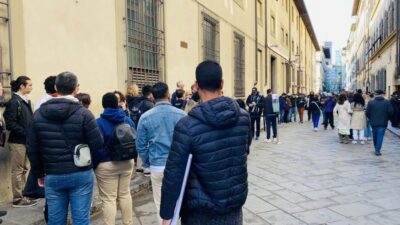 ★ 4.5Guided Walking TourFrom $313,334 reviews
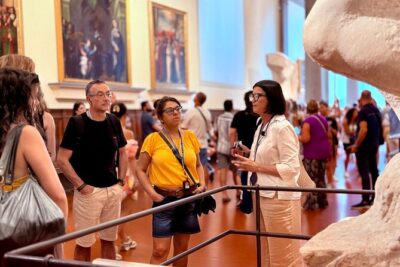 ★ 4.5Skip the line: Uffizi and Accademia Small Group Walking TourFrom $1483,135 reviews
★ 4.6Guided Walking TourFrom $271,602 reviews
★ 4.5Skip the line: Uffizi and Accademia Small Group Walking TourFrom $1483,135 reviews
★ 4.6Guided Walking TourFrom $271,602 reviews
 ★ 4.8Renaissance and Medici Tales Guided Walking TourFrom $21,549 reviews
 ★ 4.7Uffizi & Accademia Small Group Walking TourFrom $1481,380 reviews
 ★ 5.0Skip-the-Line Florence Highlights and David Walking TourFrom $1171,127 reviews
 ★ 4.6Dark Mysteries and Legends Guided Walking TourFrom $21,081 reviews
 ★ 4.5Florence in a Day: Michelangelo’s David, Uffizi and Guided City Walking TourFrom $1341,048 reviews
Find this experience in another shortlist