
Florence field review · AUDIO TOURS
Florence: Best Of – with Tour Leader & Multilingual Audio Guide
Florence in 2.5 hours is a smart move. This Florence highlights walk strings together the postcard views and the power-squares you keep hearing about, then adds commentary so the streets make sense. I liked the small-group feel, and the way the route moves you through the historic center without feeling like you are getting herded.
Two things I really like: first, the combo of a live professional guide and earphones, so the stories land even when crowds get loud. Second, you cover both the big-name stops and the in-between streets that help you picture Florence as a real, walkable city. One possible drawback to plan for is that the pace is tight, and if you are sensitive to accents or volume, you may need to stay close to hear clearly.
If you show up ready to walk, this is a solid first-tour option. Just wear good shoes and expect short pauses, not long museum time.
Key Highlights You Will Notice Fast
- Max group size of 15 keeps the walk manageable and you spend more time listening.
- Earphones included plus multilingual audio content created by an art historian.
- Lunch included with your choice of Florentine schiacciata or a charcuterie board (check options).
- Major Florence squares and bridges in one loop, with famous exteriors and the why behind them.
- Family-friendly route through the center, mostly on foot with frequent stops.
When a guide is worth having beside you in Florence
- The Best tour in Florence: Renaissance & Medici Tales – guided by a STORYTELLER★ 5.0 · 12,316 reviews
- Florence: Duomo Cathedral Guided Tour★ 3.9 · 5,970 reviews
- Uffizi Gallery Small Group Tour with Guide★ 4.5 · 4,923 reviews
- Florence: Accademia Gallery Guided Tour★ 4.6 · 4,156 reviews
What This “Best Of Florence” Walk Includes, and What You Should Expect Instead of Tickets
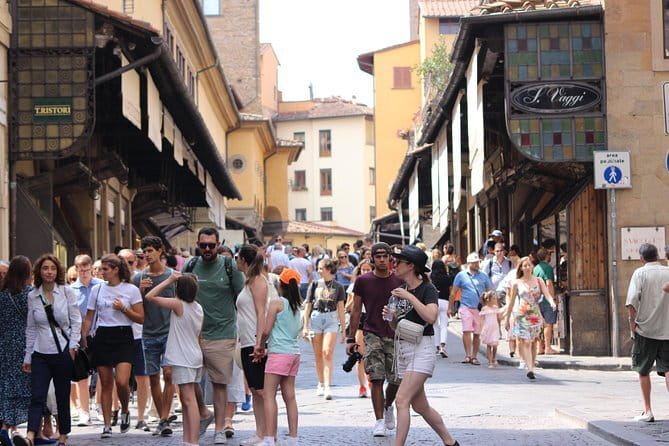
This is a walking tour focused on seeing the most iconic Florence sites from the outside and learning how they connect. The stops include famous public spaces like Piazza della Repubblica, Ponte Vecchio, Piazza della Signoria, and the Duomo area. It is not a museum-ticket tour, so you get orientation, context, and photo moments, not long timed-entry visits.
Price-wise, $17.54 per person is the kind of deal that makes sense when you compare it to buying museum admissions one-by-one. You are paying for a guided route, earphones, and a included lunch, which is a big deal if you are trying to avoid decision fatigue on your first day. If you want to actually go inside churches and museums for extended time, you will likely pair this with separate ticketed visits later.
The tour runs about 2 hours 30 minutes and tends to be booked around a month in advance. That is often a clue that it works for people who want a quick overview, not a slow, deep study. If your schedule is tight, it can be a lifesaver.
Start at Piazza di Madonna degli Aldobrandini, Then Get Oriented by Walking the Center
The tour starts at Piazza di Madonna degli Aldobrandini, 8, in Florence’s historic core. From there, you get pushed into the rhythm of Florence right away: short walks, quick stops, and lots of street-level details. If you have never been here before, this is a great way to learn which direction things are, so your later self-guided day trips feel easier.
I also like that the experience is set up for small groups (up to 15). That matters in Florence, where one wrong turn can put you into a maze of narrow lanes. A smaller group usually means fewer people blocking your view and fewer moments when you cannot hear the guide.
Piazzale degli Uffizi: The View That Makes You Understand the City Layout
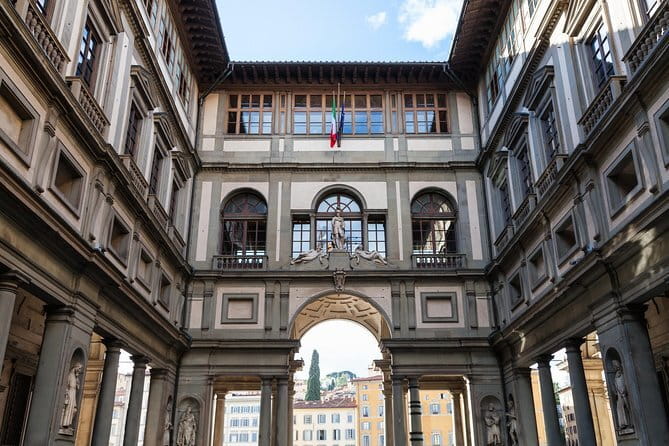
One early stop is the area in front of the Uffizi, Piazzale degli Uffizi. You pause near this gateway spot because it helps you “read” Florence, with views over the Arno River and the historic center. Even if you do not buy Uffizi tickets on this tour, you walk away with a clearer mental map of where the river fits into the old streets.
This is a good moment to look up and down. Florence’s best lines are visual: domes, bell towers, and the way streets angle toward major landmarks. The tour framing here makes the later stops feel connected instead of random.
Piazza della Repubblica: A Classic Square Break, With Everyday Florence Energy
Next comes Piazza della Repubblica, right in the heart of town. This is the kind of place where locals and visitors mix, with historic-looking arches, cafes, and shops around you. You get a breather stop here, and it is also a useful transition point between major sights.
What I find smart about including a square like this is that it breaks the “only monuments” feeling. You learn where people actually sit, eat, and wander, which helps when you later plan where to linger on your own.
Ponte Vecchio: Jewelry Shops, Old Trades, and Bridge Resilience
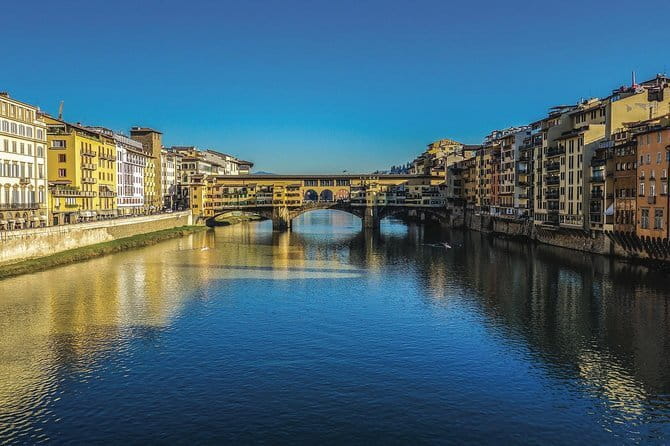
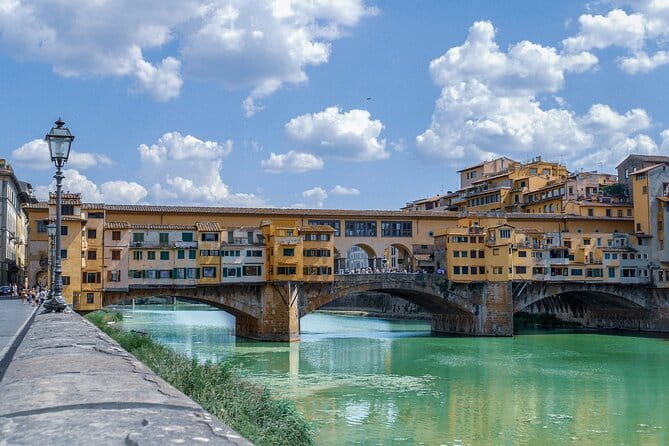
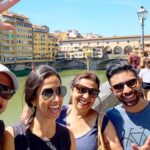
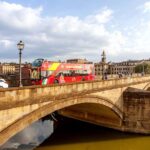
Then you are at Ponte Vecchio, the famous medieval stone bridge over the Arno. Today, the shops lining the bridge are mostly jewelry, but the bridge originally housed butchers and fishmongers. That change alone is a great Florence story, because it shows how a practical bridge became a luxury landmark.
Ponte Vecchio is also famous for surviving floods and wars over the centuries. The guide perspective here is usually about more than the view, it is about why Florence keeps rebuilding and repurposing the same spaces. If you pause at the right angle, you can see the river reflections and get a better sense of how the bridge sits in the city.
Florence at your own pace, with the route in your pocket
Palazzo Vecchio From the Outside: Florence’s Political Center in Stone
After the bridge, the route turns toward Palazzo Vecchio and the surrounding area. From outside, Palazzo Vecchio impresses with its sturdy medieval look and the imposing clock tower. Even without entry, this stop helps you understand why Piazza della Signoria matters. This is power made visible in stone and sculpture.
A practical tip: take a second to spot the structure from multiple viewpoints in the square. Florence buildings can look very different based on your angle, and the tour’s quick pauses are timed to get you that effect without wasting time.
Santa Croce and the Names That Echo Through Florence
One of the major stops is Basilica di Santa Croce. This Franciscan church is known for Gothic architecture and for housing tombs of major figures like Michelangelo, Galileo, and Machiavelli. If you have ever heard those names in class, this is where Florence turns into something more personal.
Santa Croce is also associated with famous frescoes by artists like Giotto, and it has a striking marble façade. Even if your experience here stays mostly outside or at a quick viewing pace (tickets are not included), it is still an important contrast point in the itinerary. It shifts the tone from public squares and politics to faith, art, and memory.
Museo del Bargello Area: Renaissance Sculpture in a Former Town Hall and Prison
Another stop is the Museo del Bargello, located in a former medieval palace that served as Florence’s town hall and prison. The museum is known for Renaissance sculpture, including works by Donatello, Michelangelo, and Verrocchio. Decorative arts also show up in the collection, from ceramics and textiles to weapons.
Here is the value of this stop even without a ticket: it helps you decide whether you want to return later for the real museum experience. The exterior framing gives you a name and a theme. Then, when you are planning your second or third day, you have a “why” for choosing Bargello over another museum.
Piazza della Signoria: Statues, Replicas, and the Feel of Government Square
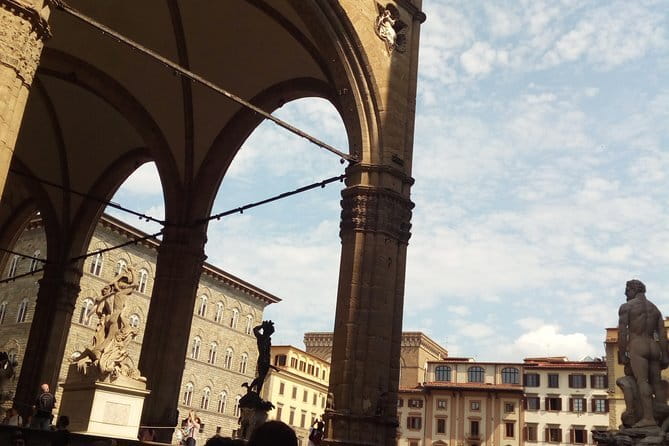
Piazza della Signoria is one of the most recognizable spaces in Florence, and the tour uses it well. You get the square’s key landmarks in context, including Palazzo Vecchio and the Loggia dei Lanzi. You also learn about major sculptures here, such as a replica of Michelangelo’s David and the Fountain of Neptune.
This is also described as the political center of Florence for centuries. That is not trivia, it is a lens. When you stand in the square, the location starts to make sense, because you see how visibility and gathering space worked for power.
Cathedral Area and the Duomo Ensemble: See the Dome Relationship in One Stop
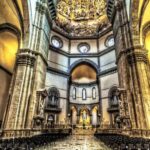
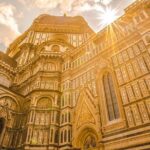
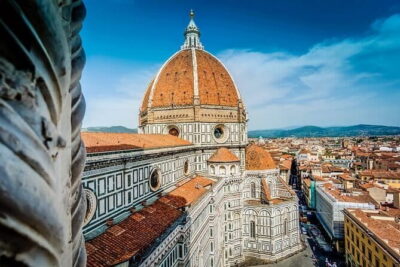
The tour then brings you to the Cathedral of Santa Maria del Fiore area, in Piazza del Duomo. You get the Duomo viewpoint with Brunelleschi’s dome dominating the skyline. The stop also points you to the related ensemble, including the Baptistery of St. John and Giotto’s Campanile.
What you get here is a “spot the pieces” moment. A lot of visitors only remember one feature, usually the dome, and then later wonder where the bell tower fits in. This stop helps you put the ensemble into a single mental picture.
Via de’ Tornabuoni: Florence’s Living-Room Street and Its Luxury Window Displays
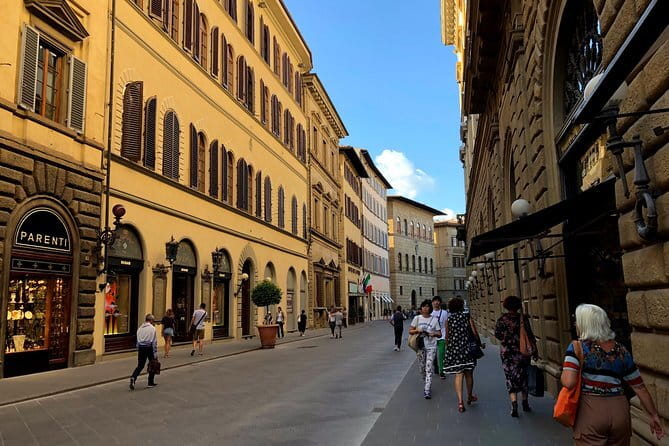
After the big architecture, the walk shifts to Via de’ Tornabuoni. This is one of Florence’s elegant streets, connecting Piazza Santa Trinita to Ponte Santa Trinita. The tour frames it as the city’s living room since the Renaissance, with noble palaces along the way.
You also get a sense of why the street is now tied to high-fashion shopping. The tour mentions boutiques such as Gucci and Ferragamo, and it also highlights Palazzo Strozzi and Palazzo Spini Feroni, home to the Salvatore Ferragamo Museum. Even if you are not shopping, it is a good contrast with the heavier political and religious areas earlier in the route.
Palazzo Pitti Outside: A Big Royal-Scale Building for Your Next Day Plan
The final major sight on the route is Palazzo Pitti. This is a Renaissance palace that started with the Pitti family and later became the residence of the ruling Grand Dukes of Tuscany and even the Italian royal family. The palace is associated with museums like the Palatine Gallery and gardens like the Boboli Gardens.
Because entry tickets are not part of this walk, Palazzo Pitti works as a look-and-plan stop. You see enough to want to come back, and you learn what collections are tied to it. If you are deciding whether to spend time in the Pitti area later, this is a helpful first glance.
Lunch Plus Earphones: How the Tour Keeps You Moving Without Losing the Story
Lunch is included, with a choice of Florentine schiacciata or a charcuterie board. This is one of those “hidden value” perks, especially in Florence where meal costs add up fast. It also prevents the classic first-day problem, where everyone is too hungry to appreciate the walking.
Earphones are provided, and the audio content is multilingual and created by an art historian. That combination matters for two reasons: you can follow the main guide even when the group gets noisy, and the extra audio gives you something to refer back to while walking between stops.
About guide styles: the experience can be led in English, and it may be operated by a multilingual guide. In the reviews, I saw guide names like Yaniel and Isabella mentioned for being friendly and informative, and Natalia and Remo for making the city feel alive. I also saw praise for guides like Costinest and Claudio when people mentioned clear communication and strong pacing.
Still, language clarity can vary day to day. Some people reported it was difficult to understand the guide’s English accent, so if audio clarity is a big deal for you, position yourself well near the front and keep an ear on the earphones from the start.
Best Time and Best Use Case: When This Tour Works Like a Shortcut
This tour is at its best if you want to get oriented quickly and understand what you are looking at. It is a smart “day one” move if you plan to return to a few places later on your own. It is also good if you are short on time and do not want to spend an entire day picking among museums.
It also makes sense for families. The route is family-friendly, and the stops are short enough that most kids and adults can handle them without melting down. You still get major Florence landmarks, but without committing to long indoor queues in the same stretch.
Two practical tips to get more out of it:
- Wear comfortable walking shoes, because the whole experience is built around moving.
- Bring water and plan for quick stops, not long breaks. Florence can feel warm even when the morning looks mild.
Should You Book This Florence Best Of Tour?
Yes, if you want a structured overview of Florence’s top sights in a small group, with earphones and lunch included. This is the kind of tour that helps you later recognize places without feeling lost, and it gives you names and themes you can build on with separate ticketed visits.
Skip it or pair it carefully if you want deep time inside major sites. This tour is about seeing and understanding from the street and squares, not slow museum immersion. And if you are very picky about spoken English clarity, it is worth arriving early, staying close, and using the earphones from the beginning so you do not miss the story.
If you treat it as your orientation day, it is a good value play. Then you can choose which museums or churches deserve your longer attention.
FAQ
How long is the Florence Highlights tour?
It lasts about 2 hours 30 minutes.
What does the tour cost?
The price is $17.54 per person.
Where does the tour start and end?
It starts at Piazza di Madonna degli Aldobrandini, 8, 50123 Firenze FI, Italy, and ends at Piazza del Mercato Nuovo, 50123 Firenze FI, Italy (Fontana del Porcellino).
Are museum entry tickets included?
No. It is a city walking tour, so admission tickets are not included.
What is included in the price besides the guide?
You get professional tour leadership, earphones to hear the guide, multilingual audio contents created by an art historian, and lunch (Florentine schiacciata or charcuterie board, depending on options).
What language is the tour offered in?
It is offered in English, and it may be operated by a multi-lingual guide.
What group size should I expect?
It has a maximum of 15 travelers.
Do I need to print a ticket?
No, you use a mobile ticket.
Is the tour family-friendly?
Yes, it is described as family friendly, and most travelers can participate.
What should I wear or bring?
Dress according to the weather forecast and plan for walking. You are also advised to be at the meeting point 15 minutes before departure.
Florence with someone who knows the room
- The Best tour in Florence: Renaissance & Medici Tales – guided by a STORYTELLER
★ 5.0 · 12,316 reviews
More Florence tours to open next
- The Best tour in Florence: Renaissance & Medici Tales – guided by a STORYTELLER
★ 5.0 · 12,316 reviews
Every Florence review, in one place
- Tuscany Day Trip from Florence: Siena, San Gimignano, Pisa and Lunch at a Winery
★ 5.0 · 21,634 reviews - The Best tour in Florence: Renaissance & Medici Tales – guided by a STORYTELLER
★ 5.0 · 12,316 reviews

Florence picks that sit just beyond this itinerary
- Florence: Duomo Complex Private Guided Tour & Optional Dome Climb
★ 5.0 · 4 reviews - Private Tour of Florence Cathedral, Bell Tower & Baptistery
★ 5.0 · 4 reviews - Michelangelo’s David Tour in the Accademia (Tickets NOT included)
★ 4.0 · 4 reviews - Exclusive Pisa Tour from Florence: With Skip-the-Line Access
★ 4.0 · 4 reviews - Full-Day Tour of Tuscany from Florence-small group up 8 pax
★ 4.5 · 4 reviews - Florence: Inferno Private Walking Tour
★ 5.0 · 4 reviews
More Audio Tours worth comparing.
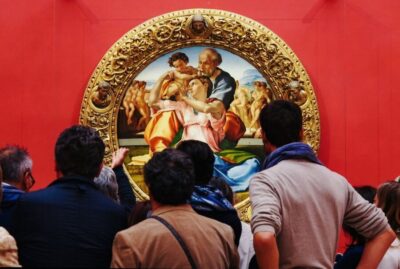 ★ 4.2Uffizi Priority Ticket & Masterpieces Audio AppFrom $316,402 reviews
 ★ 4.3Michelangelo’s David Entrance Ticket and Audio AppFrom $381,901 reviews
 ★ 4.4Uffizi & Accademia Priority Tickets with Audio AppFrom $921,253 reviews
 ★ 4.6Eco-Friendly Golf Cart City Tour with Audio GuideFrom $671,094 reviews
 ★ 4.2Uffizi Skip-the-Line Ticket & Digital Audio GuideFrom $471,044 reviews
 ★ 3.5Florence Duomo Cathedral with Host & Audio Guide (Interior Only)From $7702 reviews
 ★ 4.3Accademia Gallery Ticket with Optional Audio GuideFrom $39586 reviews
 ★ 4.1Uffizi Gallery Tickets with Optional Audio GuideFrom $55503 reviews
Find this experience in another shortlist