
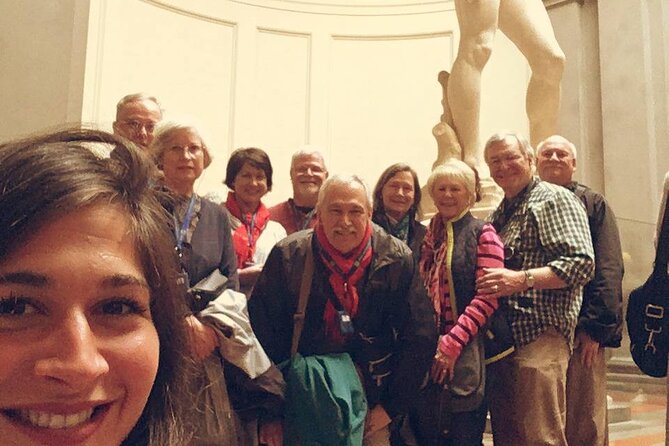
Florence field review · ACCADEMIA & DAVID EXPERIENCES
3 hour Walking Tour Statue of David and Florence Highlights
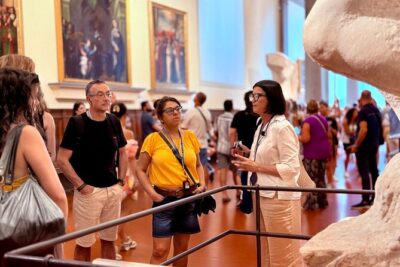
David and Florence, packed fast. This 3-hour highlights walk strings together the city’s most famous art and landmarks with a certified local English guide, so you spend less time guessing and more time seeing. You start at Piazza della Signoria, then hit the Accademia Gallery for Michelangelo’s David with skip-the-line tickets, plus quick looks at the Duomo complex and Ponte Vecchio, all in a small group of up to 19 with radio headsets (when used).
What I like most is the combination of a major indoor payoff and a smooth outdoor route. I also like that some guides who lead these tours, including Bianca, Martina, Sonia, and Valerie, are praised for clear pacing and for answering questions without rushing. The main drawback to plan around is that this is a highlights walk, not a deep interior tour, since the Duomo and Santa Croce stops are outside only, and even with reserved Accademia entry you can still face short lines due to metal detector checks.
Key Highlights You Should Know
- Skip-the-line entry for Accademia Gallery, with the practical note that you still pass metal detectors and group lines can form
- Small group up to 19, often paired with radio headsets so you can hear explanations in busy areas
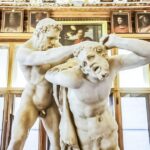
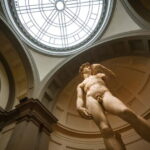
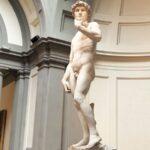
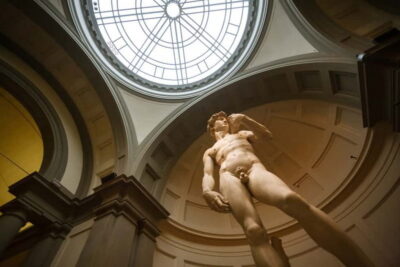
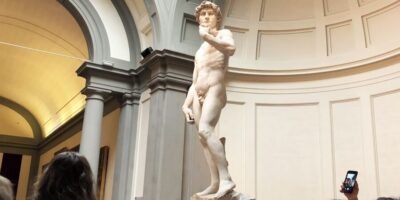
- Michelangelo’s David in person, plus context that makes the sculpture easier to understand
- Porcellino wishing tradition, toss a coin into the Pig Fountain and watch how locals do it
- Piazza della Signoria as an open-air sculpture gallery, where you see major works and myth-heavy Renaissance themes
- Duomo and Santa Croce are exterior views, so you need separate plans if you want to go inside churches
Compare the Accademia visits built around the original David
- Florence: Timed Entrance Ticket to Michelangelo’s David★ 4.6 · 16,983 reviews
- Florence: Michelangelo’s David Skip-the-Line Entry Ticket★ 4.5 · 12,764 reviews
- Florence Accademia Gallery Tour with Entrance Ticket Included★ 4.5 · 6,148 reviews
- Florence: Accademia Gallery Guided Tour★ 4.6 · 4,156 reviews
From Piazza della Signoria to Santa Croce, a Smart Half-Day Route
The tour is built for first-time Florence visitors who want the big hits without burning a day. You begin at the equestrian statue of Cosimo I at Piazza della Signoria, and you end at Piazza di Santa Croce near the church. That direction matters because it sets up a walk from political Florence and Renaissance sculpture, toward the Arno river landmarks, and then into the Santa Croce area.
You also get a group size that feels manageable. With a maximum of 19 people, the pace is brisk but not chaotic, and the guide can still help you focus on what you should notice. If your group is large enough, you’ll use radio headsets, which is a big deal in Florence where street noise and crowds can swallow a normal speaking voice.
The best part for many people is that you get a guided thread through the city. Without that, Florence can turn into a series of separate postcard stops. With the guide, each square and monument connects back to Florence’s Renaissance identity and its older Roman and medieval layers.
Accademia Gallery: Skip-the-Line Entry to Michelangelo’s David
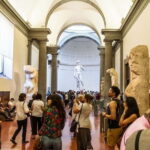
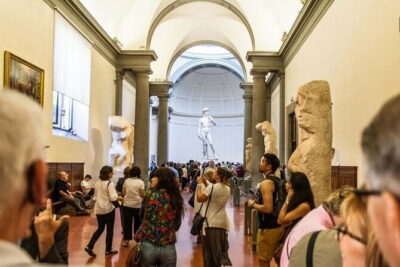
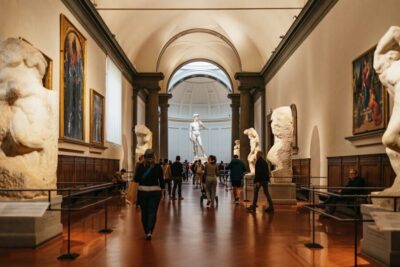
Accademia is the centerpiece. You enter the Galleria dell’Accademia with skip-the-line tickets and spend about an hour inside, focused on the Renaissance star: Michelangelo’s David. For most first-timers, this is the moment that feels the most real, because you see the scale, posture, and surface detail up close rather than through photos.
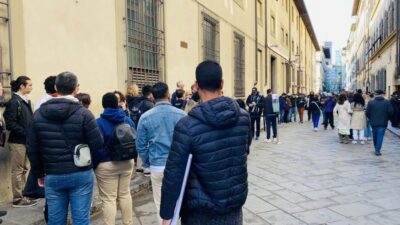
Now, here’s the practical truth to plan around: skip-the-line usually means you bypass the longest ticket queue, but you can still encounter lines at the reserved entrance because the museum has limited security equipment and checks every visitor at metal detectors. So you should not expect zero waiting, but you should expect a faster start than a walk-up ticket would offer.
What you’ll likely appreciate most inside is not just seeing David, but understanding why David mattered when it arrived. The guide’s job is to point out what to look for, then translate art choices into plain language. That is exactly what the strongest feedback highlights from previous groups: guides do more than point, they explain.
If you’re traveling with a backpack, keep an eye on Accademia rules. There is no cloakroom service, and bulky items over a size threshold are not allowed. Drinks are restricted too, so it’s smart to bring only what you need and follow the on-site rules for water and bag checks.
Duomo Complex and Baptistery Views, Without the Cathedral Interior
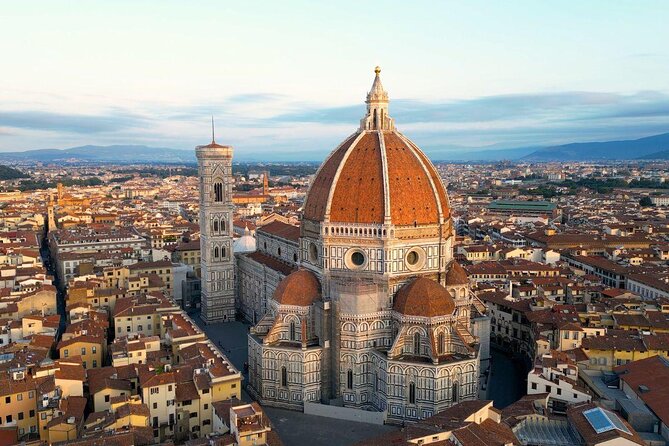
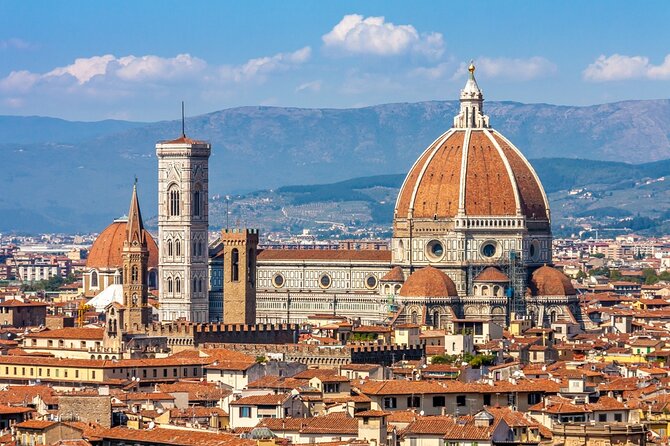
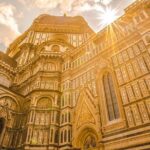
After Accademia, you step into the Duomo orbit. You spend about 15 minutes looking at the Cattedrale di Santa Maria del Fiore from outside only, along with the famous bell tower associated with Giotto and the dome work attributed to Brunelleschi. You do not go inside the cathedral on this tour, so if you’re hoping for interior highlights like specific chapels or guided worship spaces, you’ll want a separate ticket and time block.
Even outside, though, the Duomo complex works well for orientation. It gives you a landmark scale reference that helps you understand Florence’s Renaissance confidence, right in the middle of older Gothic forms. You can also learn where key structures sit in relation to each other, which makes your later self-guided exploring much easier.
The quick stop at the Baptistery of St. John adds another layer. You see ancient monument details and the look of the bronze doors that helped fuel Renaissance art ambition. Since your time here is short, don’t expect deep inspection. Instead, use it as a guided map moment: the goal is to leave knowing what’s what.
Because this route passes by places of worship, dress matters. You may be required to cover shoulders and knees, or you risk missing part of the tour. That’s not something to gamble on, especially if you’re visiting in summer with light clothing.
Piazza della Repubblica and Orsanmichele: Where Florence’s Guilds Show Up
Next comes Piazza della Repubblica, which the guide frames as the center point of the ancient Roman city of Florentia. Even if you only spend about five minutes here, it’s a useful stop because it reminds you Florence did not start as a Renaissance art machine. It has deeper roots, and the city’s layout reflects older times.
Then you move to Orsanmichele, including a stop outside the church and museum. It’s a curious building, often described as a barn turned church, and it served as a symbol of the guilds that held power in medieval Florence. You see a Gothic tabernacle element and, from outside, you can connect this building to one of the early Renaissance works by Donatello: the statue of St George.
This is one place where a good guide makes the difference. You’re not spending long here, so you need explanations that connect the building’s shape and function to the city’s political economy. The payoff is that Florence feels less like random monuments and more like a system that produced art.
Also, note the time. This is not a slow museum approach. It’s a walking highlight sequence, which is great if you want to see many things in a short window.
Fontana del Porcellino: The Pig Fountain Wishing Moment
The Fontana del Porcellino stop is quick, but it’s one of the most fun breaks in the itinerary. You arrive at the Porcellino fountain near a renaissance loggia that covers a street market. Then the guide has you participate in the tradition: toss a wishing coin into the Pig Fountain and watch the result as part of the ritual.
Locals flip coins with confidence, and it turns into a light moment in an otherwise serious art-and-architecture circuit. It also gives you a chance to regroup, take photos from the right angles, and reset before you head for the most famous bridge in the city.
If you like small local customs, this is worth showing up for. Just keep your coin handling sensible, and do not take it as a guaranteed wish device. Think of it as a playful Florence moment, not a superstition you can test scientifically.
Florence walks that make the stone streets tell the story
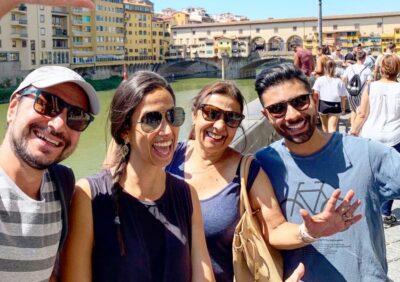
Ponte Vecchio Like a Medici-era Survival Story
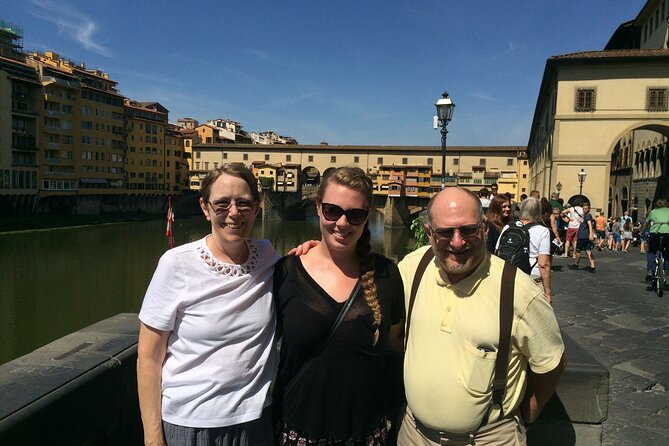
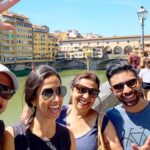
Ponte Vecchio is where the tour gets cinematic. You spend about 10 minutes at the bridge, which is famous for surviving World War II. The guide also ties it to earlier history, including the flood of 1333 that shaped how the bridge and its successors were built.
On this walk, you don’t just look at the postcard view. You learn what makes Ponte Vecchio special: the bridge’s shops and the way the space functions like a landmark marketplace. You also hear about the Vasari Corridor, the private passageway linked to the Lords of Florence and the Medici.
This stop is a great example of how a guided walk improves the experience. Without context, Ponte Vecchio can feel like a pretty bridge surrounded by crowds. With context, it becomes a story about power, control of movement, and how Florence used architecture to manage social life.
If it’s busy (it often is), keep moving with the group and choose a spot where you can see both the bridge structure and the jewelry-shop front style. That way you get the visual identity and the history without getting stuck in a photo bottleneck.
Piazza della Signoria: Florence’s Open-Air Sculpture School
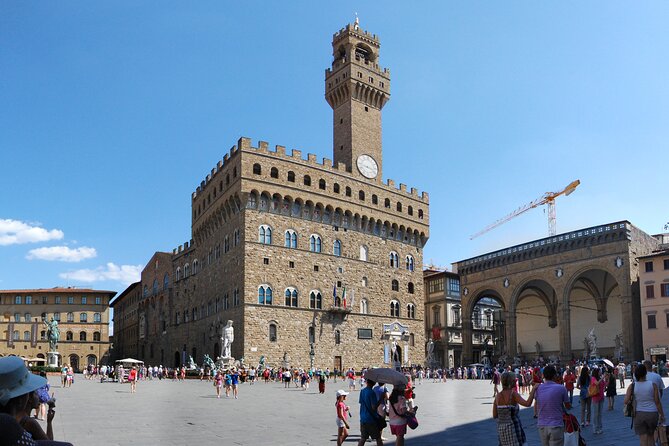
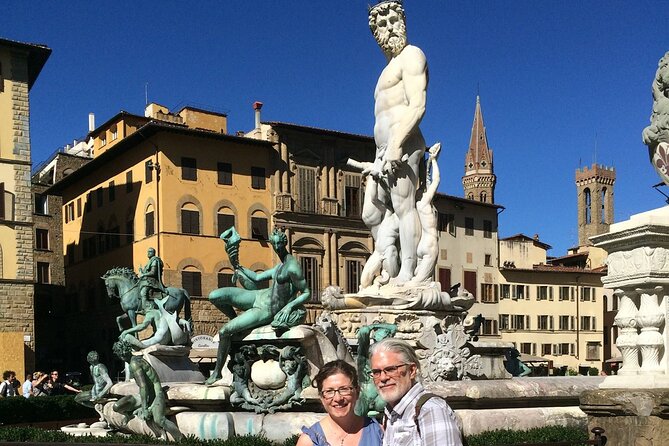
Piazza della Signoria is an anchor stop, taking about 15 minutes. You’re in the political heart of Florence, and the square works like an open-air museum because it displays major Renaissance sculpture outdoors. Even if you are short on time, this square can teach you how Renaissance artists used myth, religion, and power symbols in public spaces.
The guide points out works you can spot and mentally catalog as you walk: pieces like Cellini’s Perseus, the Fountain of Neptune, and Giambologna’s Ratto delle Sabine. You also get the larger context of how this space relates to nearby Palazzo Vecchio as part of the city’s civic identity.
Here’s the practical benefit: once you understand one piazza, you can start reading other Florence squares faster on your own. You know to look for scale, symbolism, and where the crowd stands versus where the monument expects you to look.
If you like art, this is also one of the stops where your guide’s explanations likely earn their keep. Strong feedback on this tour consistently praises clear explanation and patience, and this is where that tends to show up, since outdoors you can see the whole structure and still need help connecting it to meaning.
San Firenze to Santa Croce: Da Vinci-era Plaque and Tuscan-Gothic Finish
The route continues to Piazza San Firenze, with about five minutes to orient you. From here you can look toward the Bargello palace and tower, see the church of San Firenze, and also spot a plaque connected to Da Vinci’s time at Palazzo Gondi while he painted the Monna Lisa. Even if you do not tour the interior, this is a neat history tie-in that helps you place Renaissance artists in real neighborhoods.
Then you finish at Santa Croce. You stay outside the church for about 10 minutes, focusing on Tuscan-Gothic architecture and the tomb tradition of famous figures. The tour frames it as a final stop with big names connected to the space, including Michelangelo, Machiavelli, and Galileo.
This outside-only ending is ideal for closing the loop. By the time you reach Santa Croce, you’ve already seen Renaissance art in Accademia and outdoor sculpture at Piazza della Signoria, so the final architectural style shift feels purposeful rather than random.
Still, it’s worth setting expectations. If you want to go inside Santa Croce to see tomb spaces firsthand, this tour will not cover that. What it gives you is a solid exterior understanding plus a sense of where to aim for next.
Price and Value: What $3 Buys You in Real Terms
The price listed is $3, which is strikingly low for a tour that includes a local professional English-speaking guide, Accademia Gallery skip-the-line tickets, and radio headsets when needed. Even if you’re skeptical, do the math with the time you gain.
Three hours in central Florence can turn into a long, expensive day if you buy individual tickets last minute and end up standing in lines for David. This tour bundles the highest-demand ticket stop and then keeps you moving through the city with a guide who helps you see more than the obvious. That is how value shows up: not as a bargain feeling, but as a time-saving and meaning-making experience.
That said, remember the tour format. It’s highlights-focused. You’ll cover many major sights, but each stop is designed to be short. If you want a slow museum visit with lots of free time, you might end up wishing you had longer at one place. If you want a first-day orientation that points you toward later deeper visits, this tour fits nicely.
One more practical point: a critical review mentioned they still waited in line to see David and felt the rest of the tour was not special. Use that as a reality check. Skip-the-line does not mean zero waiting at security, and outdoor stops are brief by design. The tour works best when you treat it as a guided highlights circuit, not a substitute for independent, unhurried museum time.
Who This 3-Hour Florence Highlights Walk Suits Best
This is best for your first day in Florence, especially if your schedule is tight or you want an efficient overview of the city’s key art and civic landmarks. It’s also a strong choice for people who enjoy learning practical context while they walk, because the guide’s role is to interpret what you see instead of leaving you to guess.
It can be a great fit for families too, since the small group size supports flexibility, and feedback includes guides being patient and adjusting to needs like meeting another friend at the end.
If you want to go inside the cathedral and Santa Croce church during the same time block, adjust your plan. This tour keeps you mostly outside, so you’ll need additional tickets if interior access is on your must-do list.
If weather is unreliable, keep your expectations flexible. One piece of feedback was that heavy rain made the walking less enjoyable. Outdoor portions are unavoidable, so if rain is likely, bring a rain layer that fits church dress expectations, and keep an eye on umbrella rules at the Accademia.
Should You Book This Tour?
I think you should book this tour if you want Florence’s biggest art moment, Michelangelo’s David, plus a guided hit list of civic squares and landmarks, all within a short window. The best argument is value plus orientation: skip-the-line Accademia entry, a local guide who explains what matters, and a route that helps you understand where everything sits in the city.
I’d skip it or pair it differently if you need cathedral and Santa Croce interiors, or if you prefer long, quiet time in museums. This walk is designed to get you oriented fast, not to replace deeper tickets later.
If your goal is to get bearings quickly and come away knowing what to look for on your next Florence day, this is one of the easiest ways to do it.
FAQ
Where do I meet for the tour?
Meet at the equestrian statue of Cosimo I at Piazza della Signoria, 50122 Firenze FI, Italy. The guide will be there about 5 to 10 minutes early.
How long is the tour, and what time commitment should I plan for?
The tour runs for about 3 hours.
Is Michelangelo’s David included?
Yes. You enter the Accademia Gallery and see Michelangelo’s David, with skip-the-line tickets included for that stop.
Will I go inside the Duomo or Santa Croce?
No. The cathedral complex and Santa Croce church are viewed from outside only, including surrounding areas. Entrance to the cathedral Dome and inside Santa Croce is not included.
What should I wear if I’m passing churches?
Entrance to places of worship can have restrictions. Your clothing should cover your shoulders and knees, or you might miss part of the tour.
What are the main rules once I enter the Accademia Gallery?
You cannot bring drinks of any kind, except water bottles up to 0.5 liters. Umbrellas must be allowed and closed up, and you can’t rely on cloakroom storage. Bulky items larger than 40 x 30 x 18 cm are not allowed.
More Florence tours to open next
- The Best tour in Florence: Renaissance & Medici Tales – guided by a STORYTELLER
★ 5.0 · 12,316 reviews
Every Florence review, in one place
- Tuscany Day Trip from Florence: Siena, San Gimignano, Pisa and Lunch at a Winery
★ 5.0 · 21,634 reviews - The Best tour in Florence: Renaissance & Medici Tales – guided by a STORYTELLER
★ 5.0 · 12,316 reviews

David and the Accademia, compared
Florence picks that sit just beyond this itinerary
- Florence: Duomo Complex Private Guided Tour & Optional Dome Climb
★ 5.0 · 4 reviews - Private Tour of Florence Cathedral, Bell Tower & Baptistery
★ 5.0 · 4 reviews - Michelangelo’s David Tour in the Accademia (Tickets NOT included)
★ 4.0 · 4 reviews - Exclusive Pisa Tour from Florence: With Skip-the-Line Access
★ 4.0 · 4 reviews - Full-Day Tour of Tuscany from Florence-small group up 8 pax
★ 4.5 · 4 reviews - Florence: Inferno Private Walking Tour
★ 5.0 · 4 reviews
More Accademia & David Experiences worth comparing.
 ★ 4.6Timed Entrance Ticket to Michelangelo’s DavidFrom $2616,983 reviews
 ★ 4.5Michelangelo’s David Skip-the-Line Entry TicketFrom $4512,764 reviews
 ★ 4.5Florence Accademia Gallery Tour with Entrance Ticket IncludedFrom $456,148 reviews
Accademia Gallery Guided TourFrom $534,156 reviews
★ 4.5Florence Accademia Gallery Tour with Entrance Ticket IncludedFrom $456,148 reviews
Accademia Gallery Guided TourFrom $534,156 reviews
 ★ 4.6Timed Entry Ticket to Michelangelo’s David & eBookFrom $374,049 reviews
 ★ 4.5Skip the line: Uffizi and Accademia Small Group Walking TourFrom $1483,135 reviews
 ★ 4.5Skip-the-Line Accademia Guided TourFrom $432,327 reviews
 ★ 4.6Accademia Gallery Guided Tour with Entry TicketFrom $492,253 reviews
Find this experience in another shortlist